
Duro-Last Roofing Systems in Yuma, AZ
Prefabrication changes the arithmetic of a roof, because most of the seam work happens in a factory and the field work becomes a matter of fitting, fastening and sealing. Duro-Last is a manufacturer known for custom-fabricated PVC roofing, in which membrane sections are cut and welded to measurements taken from the roof and shipped ready to install. In Yuma, AZ, where the stress is cumulative sun far more than water, the tradeoff an asset manager weighs is speed and fewer field seams against the cost of repairing a custom sheet that cannot be matched off the shelf.
We install, repair and maintain prefabricated PVC systems of this kind, and the scope shows the cost, the date and the proof for each line.
Roof leaking now? Call 555-555-5555 for a site visit and estimate.
What does prefabrication change about the schedule?
Factory-welded sections shorten the time a roof is open. Crews roll out the sections, fasten them, weld the field seams between sections and detail the perimeter, and the building is dried in faster than with a roof that needs every seam made on site. Because a storm week in August or September can stop a crew for days, shorter exposure lowers the chance that rain finds an open roof.
The tradeoff is lead time. The sections are made to measurements, so a field survey comes first, then fabrication, then delivery. A scope that skips the survey invites misfit sections and change orders, and a panel that arrives short by a few inches cannot be stretched in the field, and each misfit is a delay that the heat season does not forgive. We take the measurements, record every penetration and curb on the roof plan, confirm the drain locations and give the owner a fabrication and delivery date, so the installation window can be set against a real calendar. A commercial roof replacement that starts with accurate measurements finishes with fewer change orders. The same survey records the slope and the drain locations, so tapered insulation or added drains can be priced into the first scope rather than discovered later. A roof in the airport and Highway 195 industrial area or along I-8 gets the same survey as a small suite, scaled to the roof.
Related Roofing Work
Other pages that cover parts of the same roof question.
Commercial Roof Replacement
South Yuma Airport and Industrial Area
Restaurant Roofing
Yuma Palms and the I-8 Retail Corridor
Membrane Puncture and Foot-Traffic Repair
Multi-Site Roof Programs
How does a PVC sheet behave in sustained heat?
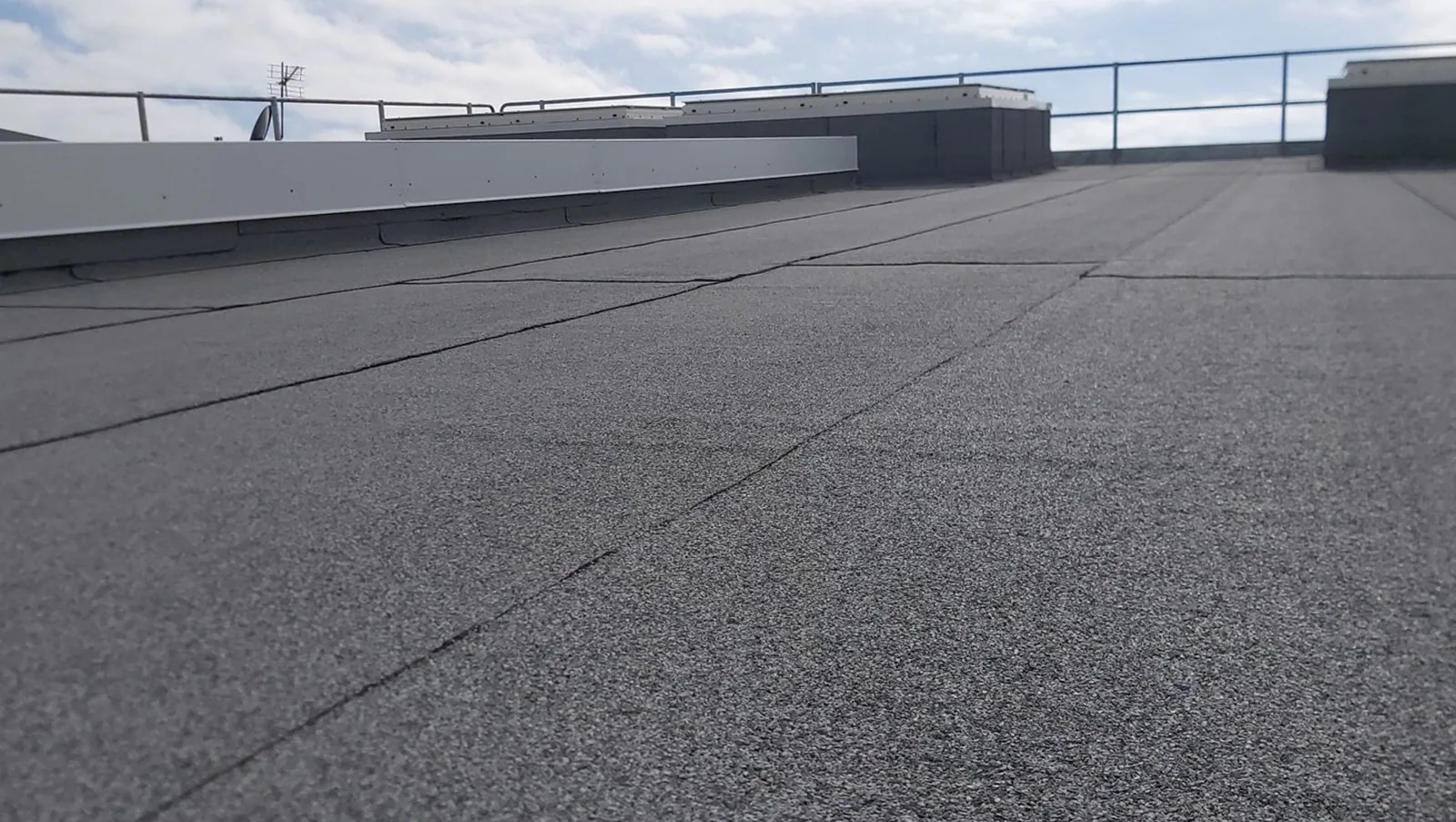
A PVC sheet stays flexible through plasticizers in the compound. Under sustained heat those plasticizers migrate slowly, and over years the sheet can stiffen, shrink back from walls and curbs or become brittle at the edges. That behavior is the reason a prefabricated roof needs a detail inspection at every wall and curb at least once a year in Yuma. The movement the sheet has to take is the daily stretch and recovery under the sun, since a freeze is rare here.
Our walk concentrates on the terminations, because shrinkage shows first there: each wall and curb is photographed from one marked position with a rule held against the gap, so a change of a few millimeters is visible between sets. When we see early pull-back, we price a detail retrofit before the gap opens a path for monsoon water. The photographs go in the binder, and over several seasons they show the owner how quickly the sheet is aging and when to plan for replacement. A manager who sees a gap widening between photo sets can move the capital line earlier, and one who sees no change can hold it, with the dated pictures as the reason either way. The photographs are taken from the same position at each wall, so the comparison is between identical frames and not between two impressions.
Which Yuma buildings suit a prefabricated PVC roof?
Restaurants, packing sheds and cold storage plants send grease, oils and vapor toward the roof, and PVC resists many of those exposures. The county's winter lettuce harvest, which runs from November to March, and its place as a trucking hub for California, Arizona and Mexico keep packing sheds, cold storage plants and distribution buildings in the local stock. Small and mid-size commercial buildings also benefit from the speed of prefabrication, since a restaurant or a small retail suite cannot afford a long roof opening.
The first walk on each building is different. For a restaurant roof, it looks at exhaust layout and grease buildup. For a packing building, it looks at vapor and penetrations. For a retail suite near Yuma Palms, it looks at equipment and tenant access. The scope lists the cost drivers for each: roof area, penetration count, exhaust layout, insulation condition and the access available for lifts and trucks.
How is a custom sheet repaired?
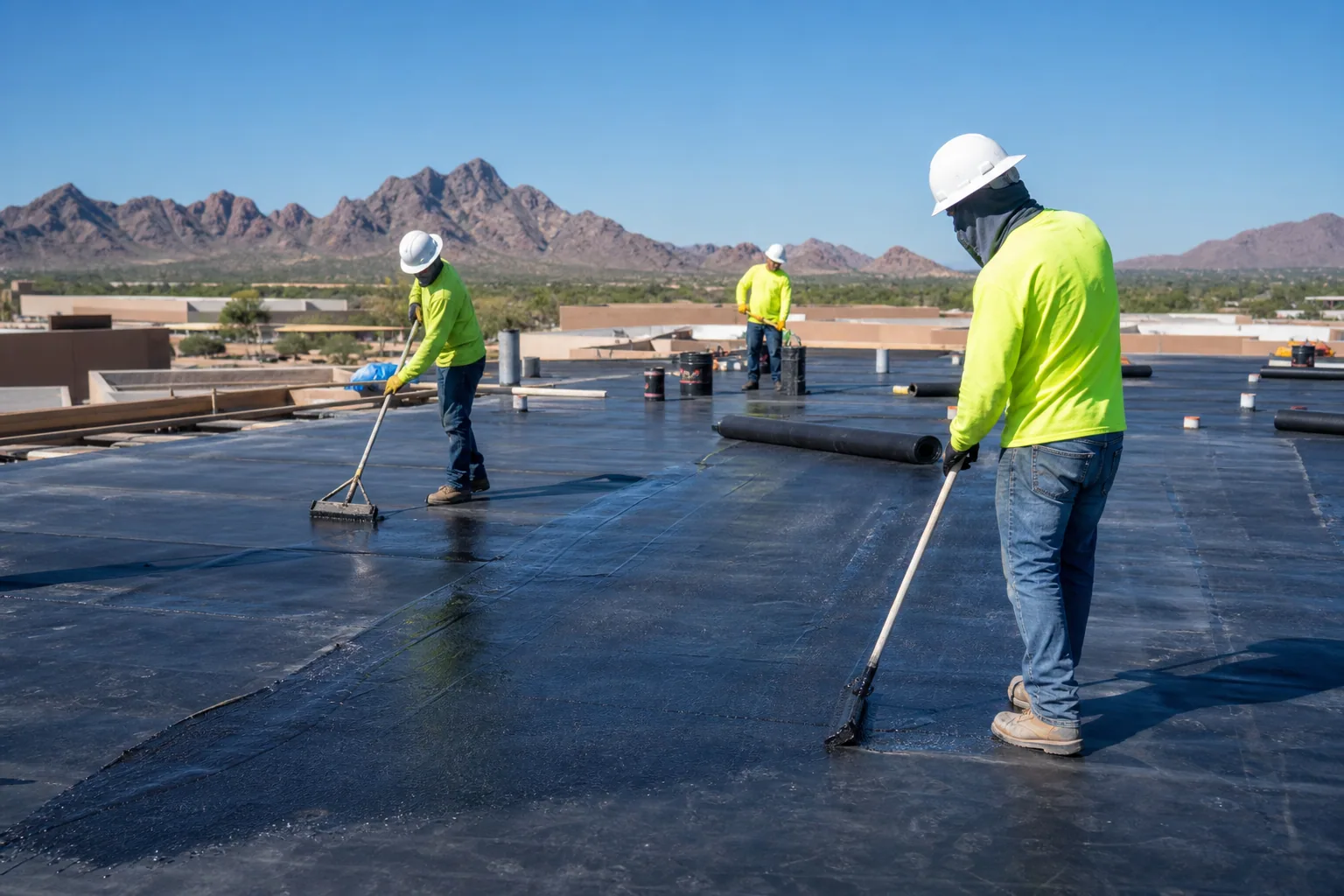
A prefabricated sheet is repaired by hot-air welding a patch or cover strip onto cleaned, prepared PVC. Only compatible material will weld to it, and an older sheet may need extra scrubbing before the weld takes, so the first pass is a trial on a small area of the existing roof.
When a roof has repeated openings at one wall, the repeat is the finding, and the next step is to look for movement, ponding or moisture under the sheet rather than weld the same spot again. A membrane puncture repair is quick, but a puncture that repeats in the same place usually points to traffic that needs a walk path. We mark the route on the roof, add walk pads where the service crews pass and note the location in the file. Where a unit needs frequent service, the pad route goes to the curb and no farther, which protects the sheet around the rest of the equipment.
What does the owner keep on file?
For a prefabricated roof the most useful page in the file is the section layout: where each factory-welded panel starts and stops, where the field seams run and which seams were made on site, because a repair crew needs that map to know where to look first when a leak shows up. Alongside it sit the dated photo sets, the temperature log and the repair history, with any warranty paperwork the owner holds. The original drawings are worth keeping, and if they are lost, our field survey rebuilds the layout.
Owners with several sites can roll the files into a multi-site roof program, where a Sika Sarnafil roof and a Duro-Last roof sit in the same inventory and read on one scale. A Versico roof elsewhere in the portfolio is recorded in the same fields, with the layout notes adjusted to its own system.
Questions About Duro-Last Roofing Systems
How long does fabrication add to a project?
Plan for a field survey, fabrication and delivery before installation starts. We give a date for each step so the owner can set the work window.
Can a custom sheet be patched with any PVC?
Only compatible PVC will weld to it, and the surface has to be clean first. An older sheet may need more scrubbing than a new one, which is why the first weld is a trial.
Is PVC worth the cost on a small roof?
On a restaurant or packing roof with grease or vapor, often yes. On a clean roof with no exhaust, TPO may do the same work for less.
What does shrinkage at a wall look like?
The sheet draws back from the base of a wall or curb, and the dated photo sets show the gap widening before it leaks.
What if the original fabrication drawings are lost?
A field survey rebuilds the layout: we measure the roof, record every seam and penetration and mark which seams were made in the factory and which on site.
Send the roof plan and any original drawings
Send the roof plan, the equipment list and any fabrication drawings you still hold, and we will return a dated scope that fits the heat-season window.
Call 555-555-5555 or email [email protected].