Commercial Roof Replacement in Yuma, AZ
A replacement is the largest roof line item a Yuma, AZ asset manager will ever carry on a single building, and the number only holds up when it rests on measured condition rather than the age printed on the last invoice. Rainfall in Yuma comes to about 3.3 inches a year, while 100-degree F weather returns on roughly 117 days, so most commercial roofs here do not fail from water first. They fail from surface temperature, ultraviolet exposure and the swing between afternoon heat and night cooling, which loosens seams, thins coatings and shrinks flashings long before a ceiling shows a stain. That is why the decision to tear off needs a file behind it: the dated photographs, the surface readings, the core samples and the moisture findings that let an owner, a lender or a board see why replacement is the cheaper path and not simply the larger one.
Roof leaking now? Call 555-555-5555 for a site visit and estimate.
What does a full replacement actually commit the owner to?
Replacement commits the owner to four things at once: removal of the old assembly, any deck repair the removal exposes, a new insulation and membrane system, and the edge metal and flashings that finish it. The first is usually the most predictable. The second is the one that moves a budget, because a deck can look sound from above and then show rusted fasteners, damp insulation or a soft section once the old layers come off. We therefore price the work in two parts: the base scope, written from the inspection record, and a unit-priced allowance for deck and insulation repair that is settled by what the tear-off reveals. The owner approves each exposed repair against photographs taken that day. Nothing is added from memory, and nothing disappears into a lump sum. For a manager defending the figure to an owner, that structure matters more than the headline total, because it shows where the cost can change and why.
Where only part of the roof has failed, we compare a full tear-off against a recover over sound existing layers and against restoration, and we show the capital cost of each over the years the owner expects to hold the building.
Related Roofing Work
Other pages that cover parts of the same roof question.
Roof Recover and Overlay
TPO Roofing
PVC Roofing
Cool Roof Installation
Yuma Palms and the I-8 Retail Corridor
Occupied Building Reroofing
When does the heat-season window open and close?
In Yuma the work calendar is set by temperature first and by storms second. Surface temperatures on a dark membrane through the long run of 100-degree days can make adhesives flash off early, soften membranes underfoot and shorten the time a crew can safely work on the deck, so tear-off and adhesive work are scheduled for the early hours and the cooler shoulder months. The second constraint is the August and September monsoon, which is also when Yuma sees its wettest weather, along with December. A monsoon outflow can arrive with strong wind, dust and a burst of rain (Yuma Proving Ground to the north has measured about 70 mph in August), and it can reach a roof that was open an hour earlier. We stage tear-off only as far as the crew can dry in by the end of the shift, and we hold a monsoon-week allowance in the schedule so a stalled week is a planned cost and not a dispute.
What does the tear-off record show?
The tear-off is the only moment an owner can see every layer of the existing assembly, so we treat it as an evidence session. Before the first layer comes up we log the condition of the surface, the location of every drain and scupper, the number of layers, and any area where the insulation has taken on moisture. As the roof opens, we photograph the deck, the fastener pattern, the attachment of the old insulation and any corrosion, each tagged to a plan sketch and dated. These photographs are the basis for any deck repair line and for the warranty file that follows. They also protect the owner later, because a future claim, a sale or a lender review can point to a dated image of the concealed layers instead of an argument about what was there.
Which assembly suits a Yuma roof?
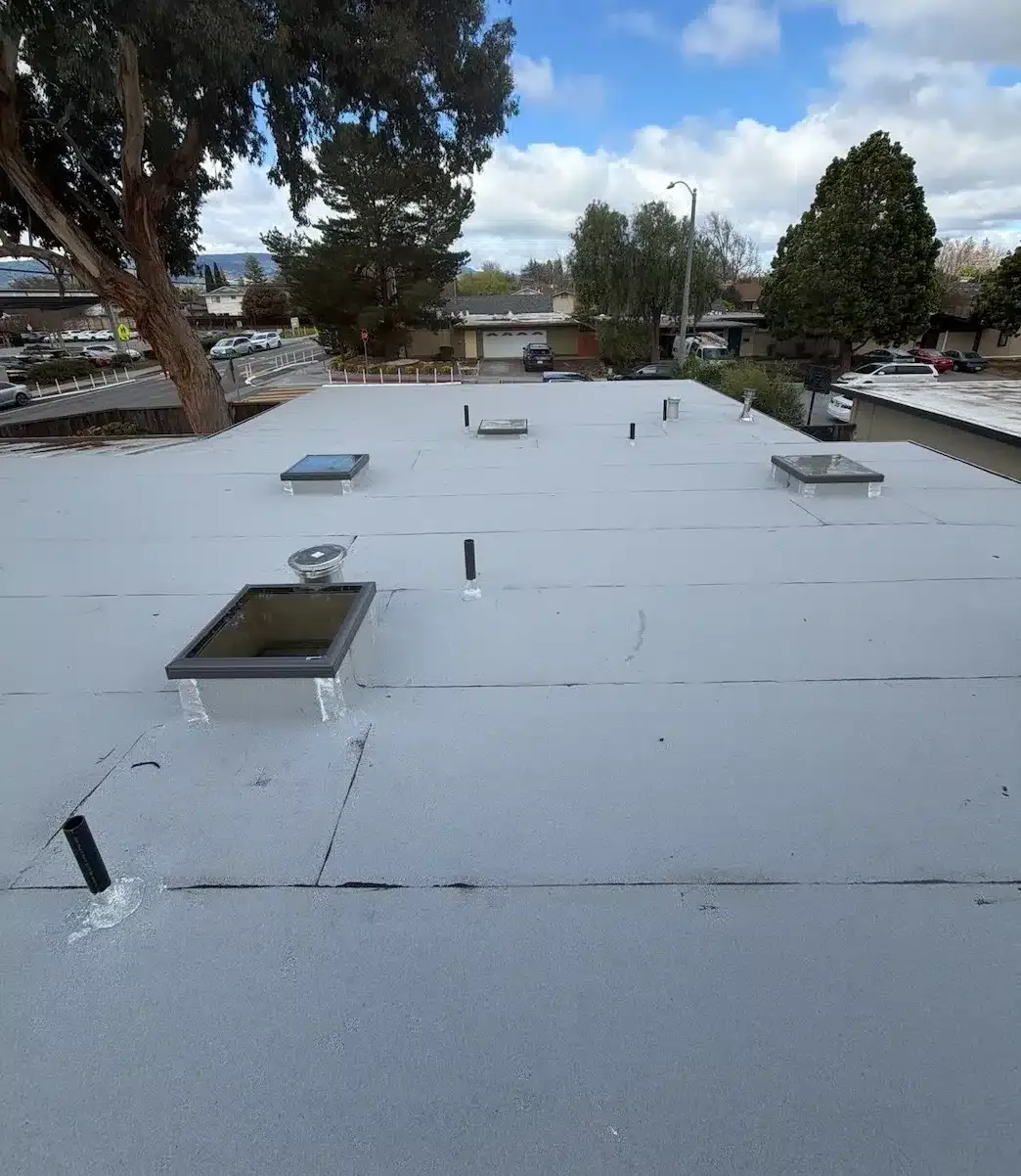
The membrane choice follows the heat load, the traffic and the building use. Reflective single-ply systems such as TPO and PVC are common choices for large flat roofs because their light surfaces reflect solar energy and their seams are welded with hot air, which suits a climate where thermal movement is constant. Insulation thickness and cover board selection matter just as much as the membrane, since a dense cover board protects the insulation from the foot traffic and pressure that wear a roof in a place where service crews work on equipment during the cooler hours. We lay out the options in writing, set the reflectance and thermal performance beside the cost, and record why the chosen system fits the building. A cool roof surface can be written into the replacement scope from the start.
How does an occupied building change the sequence?
Retail centers, medical offices and warehouses with live dock operations cannot stop for a roof, and Yuma buildings often add seasonal pressure on top of that, since winter brings the busiest stretch for the produce and distribution activity that fills Yuma County. A retail corridor such as the Yuma Palms area off Interstate 8, with a tenant mix that runs from Best Buy to a cinema, needs a phased plan: one roof section at a time, tenant access protected, noise and debris controlled, and rooftop units shut down only for the minutes a curb must be disturbed. We write the phasing into the contract as a map with dates, so a property manager can notify tenants in advance and call out the weeks that conflict with a peak sales period. Phasing of that kind is what occupied-building reroofing depends on, fitted to each property.
Questions About Commercial Roof Replacement
How do we know the roof needs replacement instead of repair?
Core samples and a moisture survey settle it. If the insulation is wet across a wide area or the membrane has lost its seams across most of the field, repair spending outruns replacement cost within a few budget cycles. A moisture survey gives the number.
Can replacement be done in the summer heat?
Yes, with early starts and a shorter working day. Adhesive and welding work moves to the cooler hours, crews rotate off the deck, and the schedule carries a hold allowance for monsoon weeks in August and September.
What does the owner approve during tear-off?
Each deck or insulation repair that the removal exposes, one by one, against a photograph taken that day and a unit price already in the contract. The owner sees the condition and the cost before the repair is made.
Will the tenants lose use of their space?
No space is closed for the roof alone. We phase the work by section, protect access routes and coordinate shutdowns of rooftop units in advance with the property manager, so each tenant knows the dates in writing.
What stays in the file after the job is finished?
The dated photographs, the installed system data, the plan with drain locations, the warranty documents and the first-year inspection date. An owner can hand that file to a lender, buyer or insurer as it stands.
What does the owner receive at closeout?
When the roof is finished, the owner receives a binder that can be handed to the next asset manager without a phone call. It contains the final plan with drain and scupper locations, the dated photo set from tear-off, the installed system and its thickness, the fastener and adhesive record, and the manufacturer warranty file where one applies. We add a walkthrough punch list with photographs of each corrected item, and a first-year inspection date that is already on the calendar. A good warranty file is not paperwork for its own sake: it is what a lender asks for at refinancing and what an insurer asks for after a monsoon claim. After that we recommend a modest annual visit under a maintenance program, since the cheapest year for a new roof is the one in which small problems are caught early.
Send the roof plan and the budget year
Send us the roof plan, the last inspection record and the year the capital is set aside, and we will return a dated scope, a deck allowance and a schedule that works around the heat season and the monsoon. Call to arrange a first walk of the roof.
Call 555-555-5555 or email [email protected].