
Commercial Roofing in San Luis, AZ
Hours are the unit of cost in San Luis, AZ, where 35,257 people lived in 2020 beside San Luis Rio Colorado, Sonora, and where a building that moves goods or customers across the line loses money by the hour when its roof lets water in. The San Luis I Land Port of Entry is the main crossing and trucks and other commercial vehicles are processed at San Luis II, so retail, agriculture and manufacturing sit close to a border that never quite sleeps. Commercial Roofing Yuma writes a San Luis roof scope as a ledger of those hours: what a wet dock, stock room or production bay would stop, what the stoppage would cost, and what the roof work costs beside it.
Roof leaking now? Call 555-555-5555 for a site visit and estimate.
What does a dock-side roof owe to the truck schedule?
Freight moving between California, Arizona and Mexico through Yuma County reaches storage and distribution buildings on a clock the roof cannot move, and Mexican Federal Highway 2 joins U.S. Route 95 at the San Luis I crossing. Dock doors, canopies and rooftop ventilation are where those buildings leak first, and our first walk follows the water from the canopy edge back across the roof: gutter condition, edge metal, the flashing where the canopy meets the wall, and every exhaust and cooling penetration above the dock.
For distribution center roofing we add a drain tally and a ponding map, since standing water over stored goods turns into an inventory claim. Each finding gets a price, and the owner chooses which items protect stock first. A failed canopy gutter is usually one of the cheaper items on the list, and fixing it keeps a wet patch off the dock apron where forklifts and trucks cross all day. Resetting edge metal and rebuilding the flashing where the canopy joins the wall belongs in the same visit, since the three items share one lift and one set of photographs.
Related Roofing Work
Other pages that cover parts of the same roof question.
Distribution Center Roofing
PVC Roofing
Manufacturing Plant Roofing
Big-Box Retail Roofing
Roof Drains, Scuppers and Ponding Correction
Roof Warranty Management
What changes when a plant runs on both sides of the border?
Light industry and assembly plants operate on both sides of the line in San Luis, and a production building carries loads a warehouse does not: exhaust stacks, makeup air, process vents and whatever those vents discharge onto the membrane. Before recommending a sheet we ask what each vent puts out, because oils or vapors landing on a roof can attack some membranes, and a chemically resistant material such as PVC may then be worth its price.
Production rarely stops for a roof, so the work is phased by zone, each zone sealed at the end of the shift, with plant safety staff deciding where lifting and hot work are permitted. The manufacturing plant roofing bid shows the phasing premium next to what a stoppage would cost, and the schedule names the permit or fire watch that each stage of the work needs before the crew lifts a torch or a welder to the roof. A register of every curb, stack and pipe, photographed and rated, becomes the working document for repairs and for any future equipment, since each addition is another opening in the roof.
How do the biggest local employers shape how bids are written?
The largest employers in San Luis include Gadsden Elementary School District, the Arizona State Prison Complex Yuma, ACT Advanced Call Center Technologies and Walmart, which is a spread of public and private buyers. Public owners compare itemized quantities and unit prices against a fixed work window. A big-box operator wants entrances open and stock dry, and an office-style employer wants quiet hours and no dust near workstations. A secure site such as a correctional complex adds access and escort steps ahead of any crew, and those steps can move a start date as much as the roofing does.
We write each bid in the form its buyer reads, from one dated survey. A big-box retail roof record numbers every drain and curb, so that a school district business office and a retail facilities director can both trace an item from the photograph to the line price.
What does Yuma-area weather do to a San Luis roof?
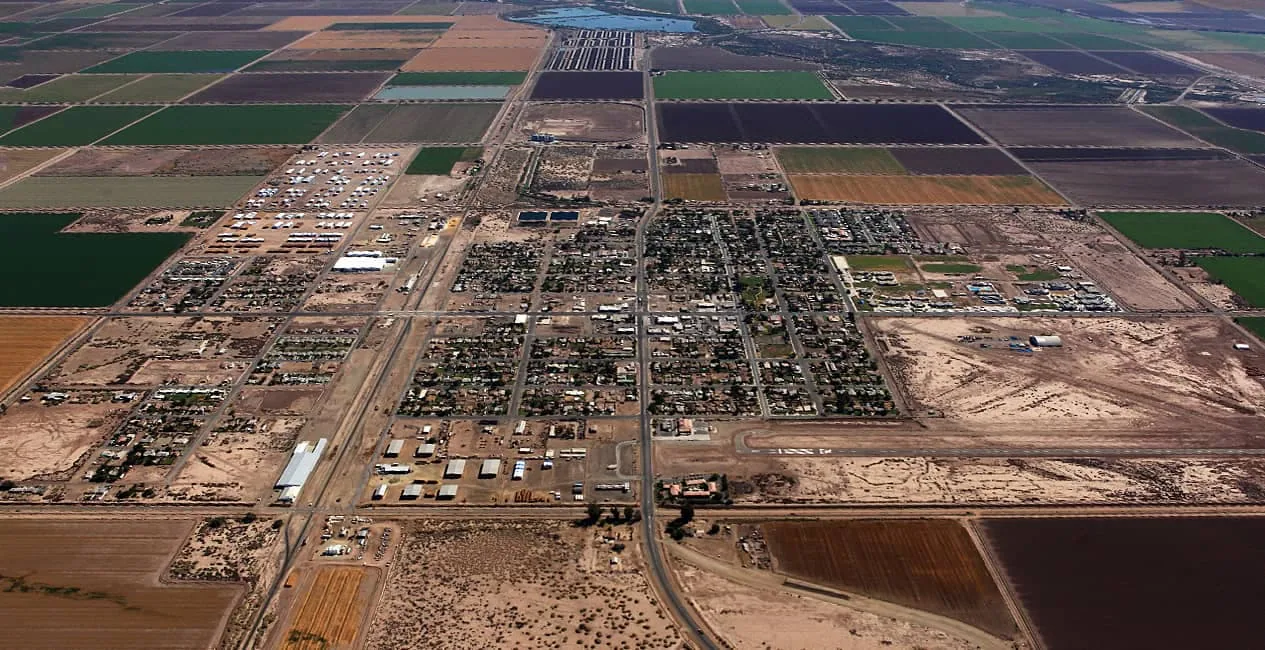
Yuma, the nearest large market, averages about 3.3 inches of rain a year, with 117 days at 100 degrees F or hotter, and San Luis lies in the same desert region. Sun ages membranes and coatings at a steady pace, while the August and September monsoon brings wind, dust and rare heavy rain. Six inches fell at Yuma Proving Ground in the 1992 season, which is more than a normal year in one burst.
The most useful visit of the year comes before that burst. Flat trade and retail roofs depend on scuppers and drains that haboob dust can plug quickly, so we clear and photograph every outlet in July and return after the first strong storm. The drain and scupper tally lists what was found and what was cleared. Surface temperature readings, taken before and after a reflective coating or a white sheet goes on, show what the change did.
What goes in the file when the building crosses hands or lenders?
A roof file earns its keep when somebody outside the building has to read it. For a San Luis owner that may be a lender reviewing a refinance, a buyer in diligence, a landlord checking a tenant's maintenance or a board weighing a capital request, and each of them asks the same things: what is the system, how old is it, what was found, what was done and what is still open. We answer in the order they ask, with a dated photo set, the drain tally, moisture results, surface readings and a deferred cost on every open line.
The same file supports a warranty file when a manufacturer's coverage is in force, because dated maintenance entries show the steps were kept. Where a tenant runs the building and an owner pays for the roof, the file also settles who is responsible for which item, using photographs and dates, not recollection.
Questions About San Luis
Can a warehouse roof be replaced with goods stored below?
In sections, yes, with protection over the stock and a seal at the end of each day. We agree which stock areas need cover before the crew starts.
What membrane suits a plant with exhaust?
The answer follows what the exhaust carries. Where oils or vapors reach the roof, a chemically resistant sheet such as PVC is priced against the alternatives.
How is a school district bid different?
It carries itemized quantities, unit prices and photographs, with the heavy work set for the break, and the business office reviews it line by line.
Why number the drains on a large retail roof?
One blocked outlet pushes load onto the others. A numbered tally shows which drain failed and when it was last cleared.
When should a spring start be committed?
By midwinter, so materials and crews line up with the cooler weeks.
What drives price and timing in a border-city building?
Roof area and condition set the base figure. Phasing and protection add cost where the building cannot close, weather allowances add days, and mobilization from Yuma is its own line, shared among all the roofs visited together. Materials ordered ahead of the cooler months arrive when the crew is ready, so an owner who commits by midwinter avoids the summer rush, and a bid that carries a storm hold for August and September shows the range up front instead of adding days later.
Lender and public-owner requirements are priced openly too, since certificates, bonds and additional-insured language can all change the number. Owners with property in Gadsden or Somerton can have the visits combined, which holds the travel line down and keeps every roof's file in the same format.
Tell us the clock the building runs on
Send the roof plan, the hours the building cannot stop and the budget year, and we will return a phased scope with the cost of phasing shown beside the roof price.
Call 555-555-5555 or email [email protected].