
Roof Insulation and Cover Board in Yuma, AZ
Insulation is the part of a Yuma roof that an owner pays for twice, once at installation and again every cooling season, which makes it the right place to be exact about what goes in. Through the long April to October cooling season, a roof assembly here works against heat gain, and the layers under the membrane decide how much of that heat the building's air conditioning has to remove. Those same layers also decide whether the roof drains. A tapered system adds the slope that a flat deck lacks, and a cover board protects the foam from foot traffic and from the stress of a hot membrane. We specify these layers by performance and price them as their own scope.
Roof leaking now? Call 555-555-5555 for a site visit and estimate.
What goes between the deck and the membrane?
Most low-slope commercial roofs use rigid polyisocyanurate board in one or two layers, with the joints staggered so heat does not travel straight through. Some use expanded or extruded polystyrene, mineral wool or composite boards for particular needs such as fire rating or compression strength. The cover board goes on top of the insulation and under the membrane, and it can be gypsum-based, fiber-reinforced or high-density polyiso. Its job is to protect the insulation, give the membrane a stable surface and improve wind and fire performance.
Each layer has a function, and a good specification names them: the insulation for thermal resistance, the tapered pieces for slope, and the cover board for protection and bonding. A roof with all three is a system; a roof with only some is a set of compromises that the owner pays for later.
Membrane choice interacts with the layers below. A TPO membrane can be mechanically attached through the board or adhered to a cover board, while a sprayed system such as spray polyurethane foam is its own insulation and is specified differently. The deck type, steel, concrete or wood, also controls which fasteners and adhesives are allowed.
Related Roofing Work
Other pages that cover parts of the same roof question.
TPO Roofing
Spray Foam Roofing
Roof Drains, Scuppers and Ponding Correction
Infrared Roof Moisture Survey
Roof Recover and Overlay
Cold Storage Roofing
How does Yuma heat change the insulation decision?
The climate pushes two ways. Insulation reduces heat entering the building, which lowers the load on air conditioning in the long cooling season. But a very hot membrane also heats the board beneath it, and some insulation facers and adhesives behave differently under sustained high temperatures. The membrane color and reflectivity matter as much as the thickness of the board: a reflective surface sheds heat that insulation would otherwise have to resist. The combination should be judged as a package.
Thermal swing is the other factor. With a record low near 21 degrees F and cool nights through much of the year, the roof assembly expands during the day and contracts at night. Boards that are loose or poorly fastened rattle, crack at the joints and print through the membrane. We match fastener patterns and adhesive to the deck type and the wind zone so the assembly stays still while the temperature moves.
Fastener spacing is part of the thermal question as well, since metal fasteners conduct heat and sit under the membrane in numbers. Adhered systems on a cover board trade fastener count for adhesive coverage, and the choice is recorded with the product so the next owner knows what is under the sheet.
When does tapered insulation pay for itself?
Tapered insulation is built from wedge-shaped boards that create slope toward the drains. It is the permanent answer for a roof that ponds because it was laid flat, and it often costs less than repeated repairs to a membrane that sits in water. We lay out a tapered plan with a drawing that shows the board thickness at each point, the drain locations, the crickets behind curbs and the slope in inches per foot. Where the structure is already fixed, the plan works around the existing drains and parapet heights.
The decision is typically made during a reroof, when the old membrane is being removed anyway and slope can be added at modest extra cost. On a recover it is harder, because added height meets parapets, door thresholds and flashing limits. Our drain and scupper counts feed directly into the taper design, and a roof that has already been proven to hold water under the old system becomes the case for correcting it under the new one.
Why add a cover board over the insulation?
Foam insulation is soft, and a membrane laid directly over it takes every footstep, dropped tool and thermal movement as stress. A cover board spreads the load, protects the insulation from the heat of fully adhered membrane installation, and gives the adhesive a clean, uniform surface. On roofs where rooftop technicians walk to units daily, the difference shows in fewer punctures and fewer seam failures near the walk paths.
Cover board also improves fire and wind ratings in many assemblies, and some manufacturer warranties require it. The cost is a modest line on the bid, and the alternative is a thinner, more vulnerable system that fails earlier. For a roof planned to last, the board is cheap protection for the most expensive layer under the membrane.
The board also changes how repairs behave later. A roof with a cover board takes a patch cleanly and lets a crew scrape out a failed seam without gouging foam, which keeps the cost of a future repair low and keeps moisture out of the insulation during it.
What do we do with wet insulation?
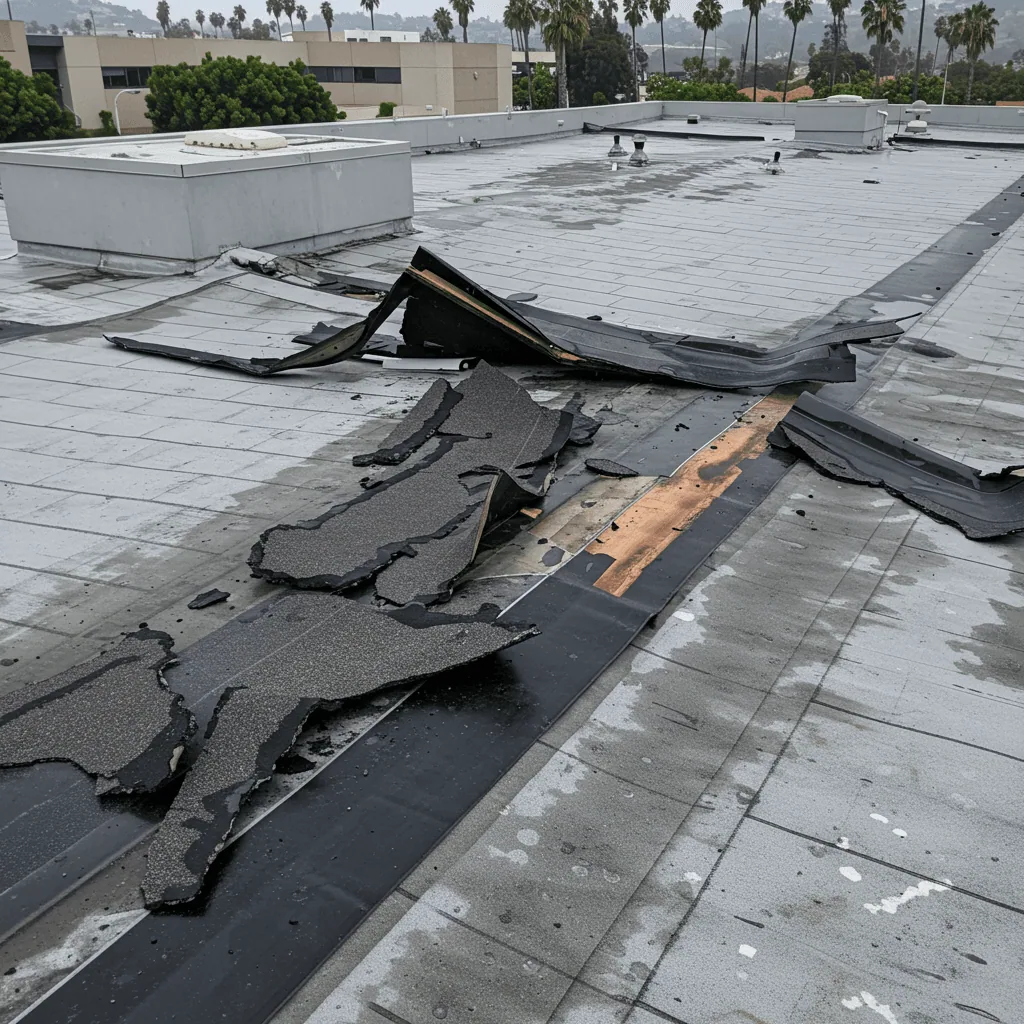
Wet insulation does not insulate and it holds water against the deck. An infrared moisture survey maps the wet areas, and core cuts confirm what the scan suggests. In a dry climate wet areas come from leaks at penetrations and drains, not from general condensation, so the mapping often leads straight to a failed flashing. Small wet zones can be cut out and replaced with new board and a patched membrane. When the wet area is widespread, the case for a recover weakens and a full tear-off to the deck becomes the sensible scope.
Whatever is removed gets weighed and logged. The record of wet board by area, with photos of the cut, is evidence for the claim file, the warranty discussion and the next survey, and it shows the owner what the roof had been holding.
Questions About Roof Insulation and Cover Board
How thick should the insulation be?
Thickness is set by the energy code in force and the owner's cooling goals. We confirm the requirement with the building department before pricing a replacement.
Can new insulation be added over the old on a recover?
Often, when the existing layers are dry and attached. The added height must clear parapets and flashings, so we check those before agreeing to it.
Does a cover board change the warranty?
Many manufacturers specify or require a cover board for particular assemblies. Using the specified one keeps the warranty terms intact.
Will tapered insulation raise the roof edge?
It raises the high points of the roof, usually at the center or the farthest point from the drains. Edge height at the drains stays similar.
What if only part of the roof needs new insulation?
A section can be replaced when the wet area is mapped and the surrounding roof is sound. The new board is tied into the old and the membrane patched.
Which roofs depend on insulation most?
Cold storage buildings serving the produce and trucking trade need insulation that works in both directions, keeping heat out of a refrigerated interior while resisting vapor drive. Distribution sites around the airport and industrial district, such as the new 290-acre industrial site beside Highway 195, will need specifications written for the cooling load and for whatever energy requirements the building department applies. Hospital roofs at Onvida Health must hold interior temperature steady for patient areas below. Retail roofs such as those at Yuma Palms carry rooftop equipment over tenant space, which makes the cover board more important than the extra inch of foam.
Specify the layers before you price the membrane
Send the roof plan, the deck type and the last survey, and we will return a layered specification with taper layout, cover board and a priced scope ready for the capital line.
Call 555-555-5555 or email [email protected].