
Seam Failure Repair on Yuma, AZ Commercial Roofs
An open seam is the first sign many Yuma, AZ asset managers see, and by then the cause has been working for years. The roof gets about 3.3 inches of rain annually, so a seam can sit partly open through an entire dry season and show nothing inside the building, while roughly 117 days of 100-degree heat each year pull the sheets one way in the afternoon and back at night. Each cycle puts a small strain on the weld or adhesive line, and the strain accumulates until a seam that passed inspection at installation has a visible gap. The first heavy December rain or monsoon week then finds it.
We map seams the way an accountant maps a ledger, run by run, with a number, a photograph and a repair price for each, so the owner can see the deferred cost before the water does.
Roof leaking now? Call 555-555-5555 for a site visit and estimate.
What actually pulls a seam apart on a hot roof?
Four forces work together. Thermal movement is the constant one: sheets expand and contract, and the seam is where the movement concentrates. Aging is the second, as plasticizers leave the membrane and the sheet stiffens and shrinks. Poor original workmanship is the third: a weld made when the membrane was damp, dirty or too cool leaves a weak line that opens early. The fourth is mechanical stress, from foot traffic along a seam, equipment vibration or wind lifting a loose sheet.
Cold weather matters little in Yuma, since the record low is about 21 degrees and freeze-thaw is rare. The movement that matters is the stretch and recovery of the sheet from one day to the next. We identify which force applies before writing the repair, since a seam opened by age needs a different fix than one opened by a bad weld. The answer drives the price and the repair method.
Related Roofing Work
Other pages that cover parts of the same roof question.
Infrared Roof Moisture Survey
TPO Roofing
PVC Roofing
Commercial Roof Repair
Roof Coating Restoration
Ponding Water Roof Repair
How is a seam map built, and why does it matter?
We walk every seam run with a probe, testing the edge of each weld for adhesion and marking any run where the probe slides in. Each run gets a number on the roof plan, a dated photograph and a condition note: sound, lifting, open or split. An infrared moisture survey adds the question of whether water has already reached the insulation below an open seam.
The map matters because it turns a vague complaint into a count. An owner who knows exactly which runs are open and which are sound can budget the repair, while an owner who is told the seams are tired cannot. The same map becomes the baseline for the next visit, and it shows whether a lifting run is stable or moving. When a seam is still intact but under strain, we record it so that it can be watched, rather than repaired before it needs it.
How are single-ply seams repaired, and when are they replaced?
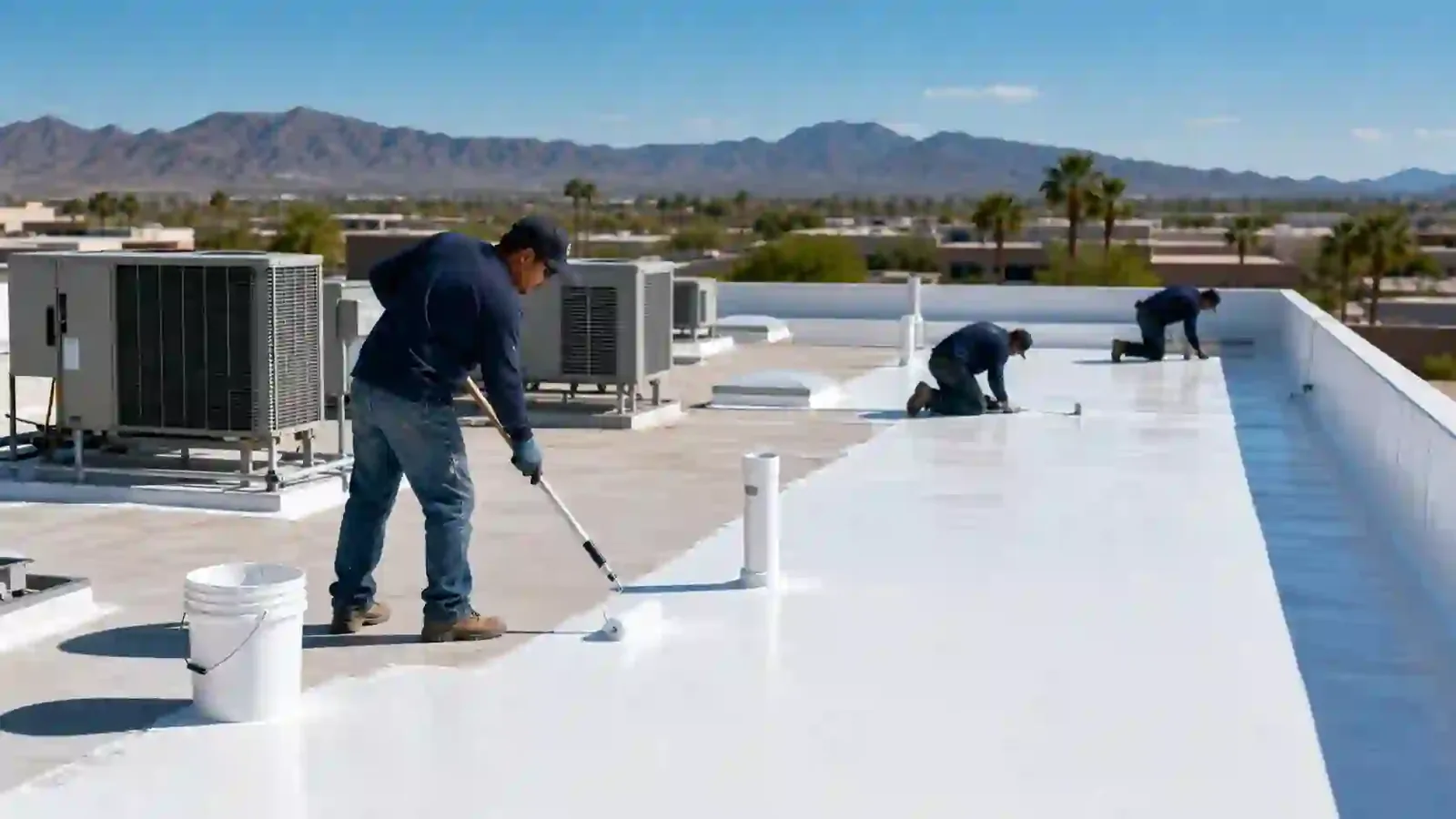
On a TPO roof or a PVC roof, a lifted or open seam is cleaned, prepared and re-welded with hot air, or covered with a welded cap strip of compatible membrane. The preparation matters more than the weld: dust, silt from haboob storms and surface oxidation must be removed or the new weld will not hold. We probe the repair after it cools and photograph it. Above occupied floors, as on a medical building, seam work is done in sections that are closed the same day.
Where the membrane has shrunk or become brittle, a weld does not last, and the repair becomes a patch over a wider area. When seams are failing across much of the roof, the cost of repeated repairs approaches the cost of replacement or of a restoration system, and we put those options next to each other in the scope. Warranty dates matter too: a seam found open inside the manufacturer's coverage period is a different conversation from one found after it, and the dated map shows which side of the line the finding falls on. A single repair is part of broader commercial roof repair, while a roof with widespread seam failure belongs in a replacement conversation.
What about modified bitumen, built-up and metal seams?
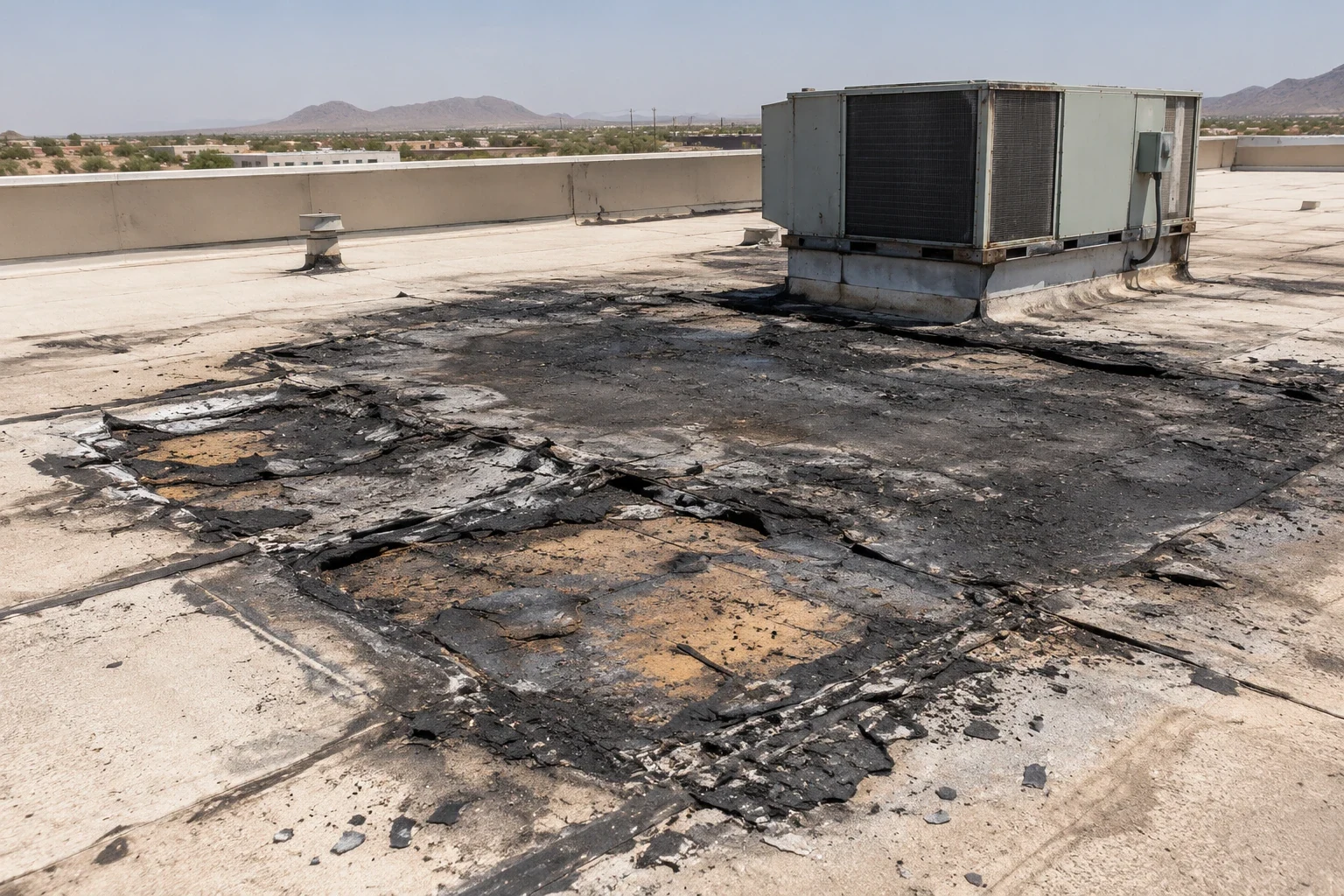
Other systems fail at their joints in their own ways. Modified bitumen laps open when heat softens the asphalt and the lap moves, and the repair is a heat-welded or cold-applied patch over the lap. Built-up roofs have felt laps and flashing joints that blister and split. Metal roofs have panel seams and fastener holes that loosen from thermal movement, and the fix is resealing, replacing fasteners and, in some cases, adding a coating over sound panels.
A coating over a sound seam can extend its life, and roof coating restoration is often part of a plan for roofs whose seams are tired but not open. Coating over an open seam, however, hides the problem for a season at most. We repair first, then coat, and each step carries its own line in the scope. Where seams in a ponding area have opened, the repair pairs with ponding water repair.
Where do seam problems show up on large commercial roofs?
They show up wherever the roof has the most movement and the most traffic. On a multi-tenant retail roof, as in the Yuma Palms corridor where rooftop units need service, damage collects along walk routes and around equipment. On an industrial roof near Yuma International Airport, we look at expansion points and the long edges where wind pulls hardest.
The result is a pattern, and a pattern like that tells the next survey where to look first. The pattern also belongs in the report: an owner who learns that most failed seams sit along a service route can add walkway pads and reduce the problem at far lower cost than repairing it every year. The mechanical contractor, who sets the route, is part of that conversation. A new building at the Panattoni industrial site beside Highway 195 would face the same heat cycle from its first summer, and a seam map taken at turnover gives that owner a baseline against which later movement can be read. Heat and UV damage often accompanies seam failure, and the two are assessed together.
Questions About Seam Failure Repair
Can a seam be repaired without replacing the roof?
Yes, when the membrane on either side is still flexible and clean enough to weld or bond. A brittle or shrunken sheet will not hold a new seam, and the scope will say so.
How can a manager tell an open seam from a normal seam line?
A sound seam is flat, tightly bonded and even along its length. An open seam shows a visible gap, a lifted edge or dirt tracking inside the lap, and a probe slides in where it should meet resistance.
Do open seams always leak?
Not immediately. In a dry climate an open seam can sit unchanged for months, but it is a path for the next heavy rain, and wet insulation is far more costly than the seam.
What does the warranty file need after a seam repair?
Photographs of the repaired run, the date, the material used and the method. Many warranties require repairs to follow the manufacturer's details, so we record how each was done.
How long does a welded seam repair last?
A repair on a sound membrane can last as long as the surrounding roof. A repair on an aging sheet may need to be redone when the sheet continues to shrink, and the report notes which case applies.
Send the roof plan and the last inspection record
Send the roof plan and any past inspection photographs, and we will map every seam run, test it and return a numbered repair list with a price for each run.
Call 555-555-5555 or email [email protected].