
Ponding Water Roof Repair in Yuma, AZ
Ponding on a Yuma, AZ roof is a line item that hides for years and then arrives all at once, because the market gets about 3.3 inches of rain annually and an owner can walk a flat roof in July without ever seeing standing water. Then a December storm or an August monsoon week drops a season's worth of rain in an afternoon, and the low spots that nobody noticed hold water for days. The 1992 monsoon put six inches of rain on Yuma Proving Ground, north of the city, in one burst, which is the kind of load a flat roof has to carry even after months of dry weather.
We treat ponding as a measured condition with a dated record, because the repair that suits a shallow dip is not the repair that suits a failed slope, and the owner should see the difference in the price.
Roof leaking now? Call 555-555-5555 for a site visit and estimate.
Why does water stand on a roof in a market this dry?
Four causes account for most of it. The first is design: a roof built nearly flat, with drains too few or set too high, will hold water in every storm. The second is deflection: the deck or framing has sagged between supports, creating a basin. The third is blockage: dust from haboobs, windblown debris and leaves fill drains and scuppers, and in a dry climate nobody notices until the next heavy rain. The fourth is membrane and insulation compression under heavy traffic or equipment, which leaves a depression where water settles.
Heat adds a fifth effect over the long run. On the roughly 117 days each year that reach 100 degrees, a hot membrane under a loaded curb or a stack of stored material takes a footprint that holds water later. We identify which cause or combination applies before choosing a repair, because clearing a drain will not fix a sagging deck and re-sloping will not help a blocked scupper.
Related Roofing Work
Other pages that cover parts of the same roof question.
Infrared Roof Moisture Survey
Roof Drains, Scuppers and Ponding Correction
Downtown Yuma
Roof Insulation and Cover Board
Silicone Roof Coatings
Seam Failure Repair
How is ponding measured so the owner can decide?
We wait for a day or two after a rain, then walk the roof and mark every area that still holds water, measuring depth with a straightedge and photographing each area with a scale reference. The record shows location, approximate area and depth, and we repeat it after a second rain to see which areas drain slowly and which never do. A roof with a few shallow patches that clear within a day is a maintenance item. A roof with deep areas that hold water for days is a design or structure problem.
An infrared moisture survey tells us whether the insulation beneath a ponding area is wet. If it is, the repair goes beyond the surface, because wet insulation loses its value and adds weight to a roof already deflecting. The survey and the ponding record together give the owner the facts needed to choose between a drain fix, a local re-slope or a larger replacement. Both documents go into the inspection binder, so the next survey can show whether a basin is growing or holding steady.
Is a drain and scupper tally enough to fix it?
Sometimes, and it is the cheapest place to start. We count drains and scuppers, check each for blockage, damaged strainers and incorrect height, and compare the count to the roof area. A roof with one drain serving too much area, or a scupper set above the low point of the roof, will pond by design. Drain and scupper work covers cleaning, resetting, adding drains, installing overflow scuppers and replacing damaged sumps.
Flat roofs in Downtown Yuma sit inside a historic landmark district, where adding drains may involve interior piping or exterior scuppers that change a visible edge, so the repair is reviewed with the owner for what can be seen from the street. On newer commercial buildings, the question is usually whether the original design had overflow protection at all. An overflow scupper is inexpensive and protects the structure if a primary drain clogs during a heavy storm.
When is tapered insulation the right correction?
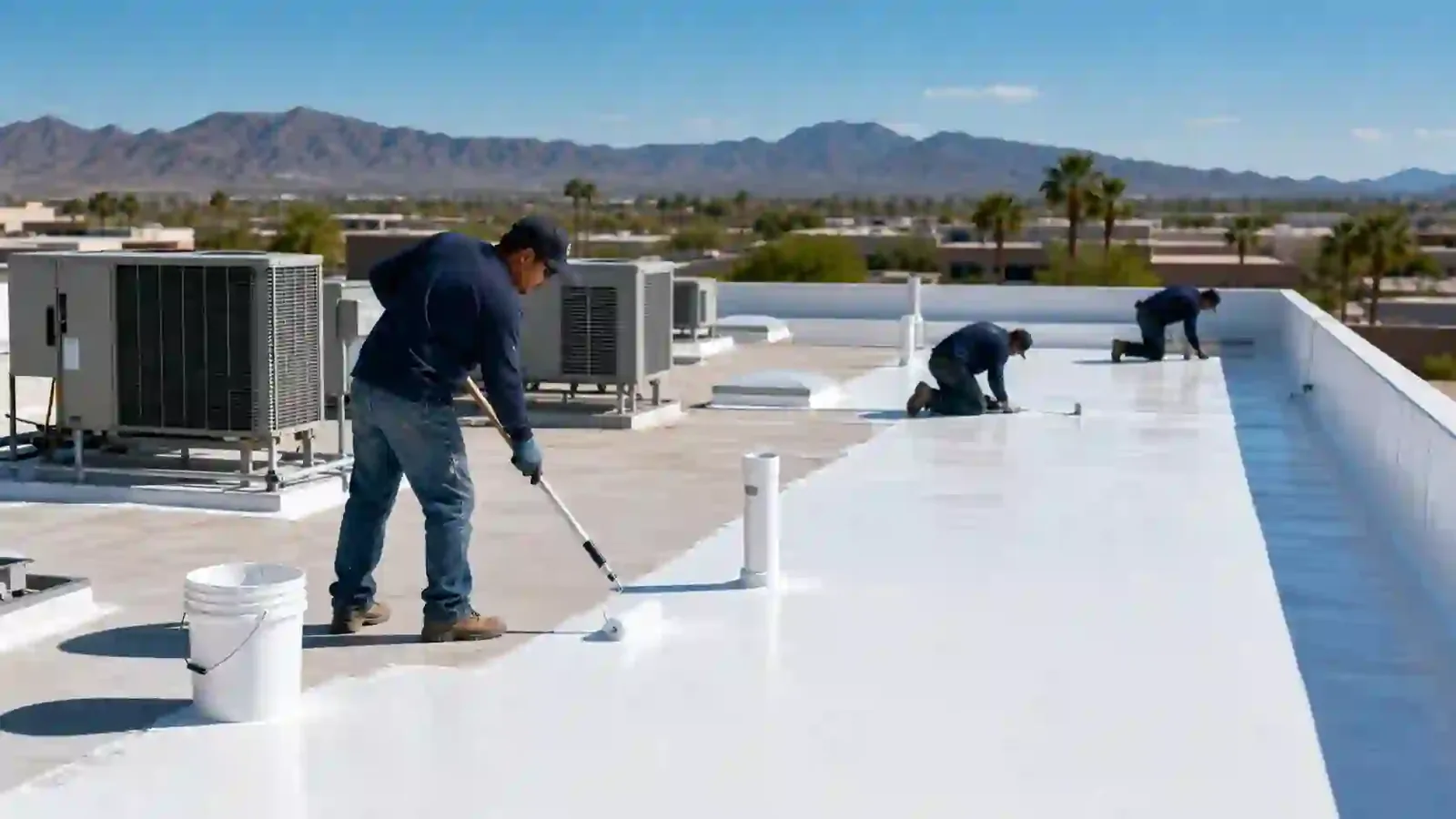
Tapered insulation adds slope to a roof that does not have enough, building up the low area so water runs to the drain. It is a larger project than a drain fix because the membrane has to be removed or recovered, but it solves a design problem permanently. We lay out a tapered plan, with crickets behind equipment and saddles at drains, so every part of the roof sheds water toward a drain or scupper.
Crickets behind rooftop units get particular attention, since a unit that blocks flow across a roof creates a dam on its uphill side. The price depends on the area needing slope, the thickness of the tapered boards and whether the existing membrane can be reused. A local re-slope around a single ponding area costs far less than a full tapered system, and it is a reasonable choice when the rest of the roof drains well. When the roof is due for replacement anyway, building slope into the new insulation and cover board assembly is the most efficient time to do it, since the old membrane is already off.
What does standing water do to the membrane itself?
Water on a hot roof does not behave like water on a cool one. It heats through the afternoon, then cools at night, and the membrane under the pond cycles through a wider range of temperature than the dry surface beside it. Dirt and dust gather at the edge of the pond and leave a ring that holds moisture. Seams within the ponded area are exposed to water for days, and any weakness in the seam is tested.
Some membranes tolerate ponding better than others. Silicone coatings are often chosen where ponding cannot be fully removed because they resist standing water, and a silicone roof coating over a sound base can protect a low area. Coatings do not fix the low spot, though, and the owner should not treat a coating as a substitute for drainage. Where ponding has already opened a seam, seam failure repair is part of the same scope, and where heat has aged the surface, the work overlaps with heat and UV damage repair.
Questions About Ponding Water Roof Repair
How long can water stand before it is a problem?
Many manufacturers treat water that is still standing a day or two after rain as ponding, and the longer it stays, the more it stresses seams and the structure. Water that lingers on a Yuma roof through a hot afternoon will also drive evaporation residue into the surface. We record how many days each area holds water and rank the repairs by that duration.
Does ponding void a manufacturer warranty?
Some warranties exclude damage from ponding water, and the terms differ between manufacturers. We read the warranty paperwork before recommending a repair and note any exclusion in the report.
Can a coating alone solve the problem?
A coating can protect the membrane inside a ponded area, but it does not remove the water. If the structure is deflecting or the drains are missing, the coating only delays the next repair.
What does ponding do to the structure?
Water is heavy, and standing water adds load to a deck that may already be deflecting. We report any areas of concern to the owner so a structural engineer can review before heavy work begins.
How much does a ponding fix cost?
The price follows the cause. Cleaning a clogged drain is a small item, adding drains is a moderate one and a tapered re-slope is a larger one. We price each option on its own line.
Send the roof plan and a photo after the next rain
Send the roof plan and photographs of any standing water after a rain, and we will measure the ponding, tally the drains and return a dated scope with the repair priced by cause.
Call 555-555-5555 or email [email protected].