A Roofing Partner for General Contractors in Yuma, AZ
The roofing line in a general contractor's Yuma, AZ budget is small next to the structure, and it causes a disproportionate share of the schedule fights. The roof is the last major system to close the building, it carries every rooftop unit the mechanical sub sets, and it must be dry before drywall and finishes go in. Where 100-degree afternoons come on roughly 117 days of the year, the roof also sets how many hours a day a crew can work, and an August or September storm week can hold the dry-in date regardless of how well the rest of the job is running. We work for the GC who needs the roof closed on a date, with paperwork the owner's lender will accept.
The way we do that is to treat the roof as a coordinated scope with its own sequence, not as a subcontract that appears when the steel is done.
Roof leaking now? Call 555-555-5555 for a site visit and estimate.
What does the roofing scope need to say before it is bid?
A scope that works for a GC states the system, the deck, the insulation, the slope strategy, the edge metal, the penetrations by count and the warranty the owner expects. It also states what the roofer does not do: curb construction, structural patching, rooftop unit setting and sheet metal outside the roof edge, each of which belongs to another trade. When those lines are blurry, the roofer prices a gap and the GC pays for the same item twice.
We read the drawings for drains, tapered insulation and overflow provisions before a number goes out, since a roof that cannot drain in a monsoon week becomes a claim. We also flag details that cannot be built as drawn, such as flashing heights at a low parapet or a curb too close to an edge. Raising them at bid time costs nothing, while finding them during installation costs days. Each flagged item goes back to the architect as a written question with a photograph or sketch, so the answer arrives in the submittal log and not in a phone call nobody records. Curb locations are the clearest case, because every equipment curb and support needs flashing room on all four sides before a unit can be set.
Related Roofing Work
Other pages that cover parts of the same roof question.
Rooftop Equipment Curbs and Supports
Solar-Ready Roofing
South Yuma Airport and Industrial Area
Occupied Building Reroofing
Roof Warranty Management
School Districts
How does the roof fit with the mechanical and electrical trades?
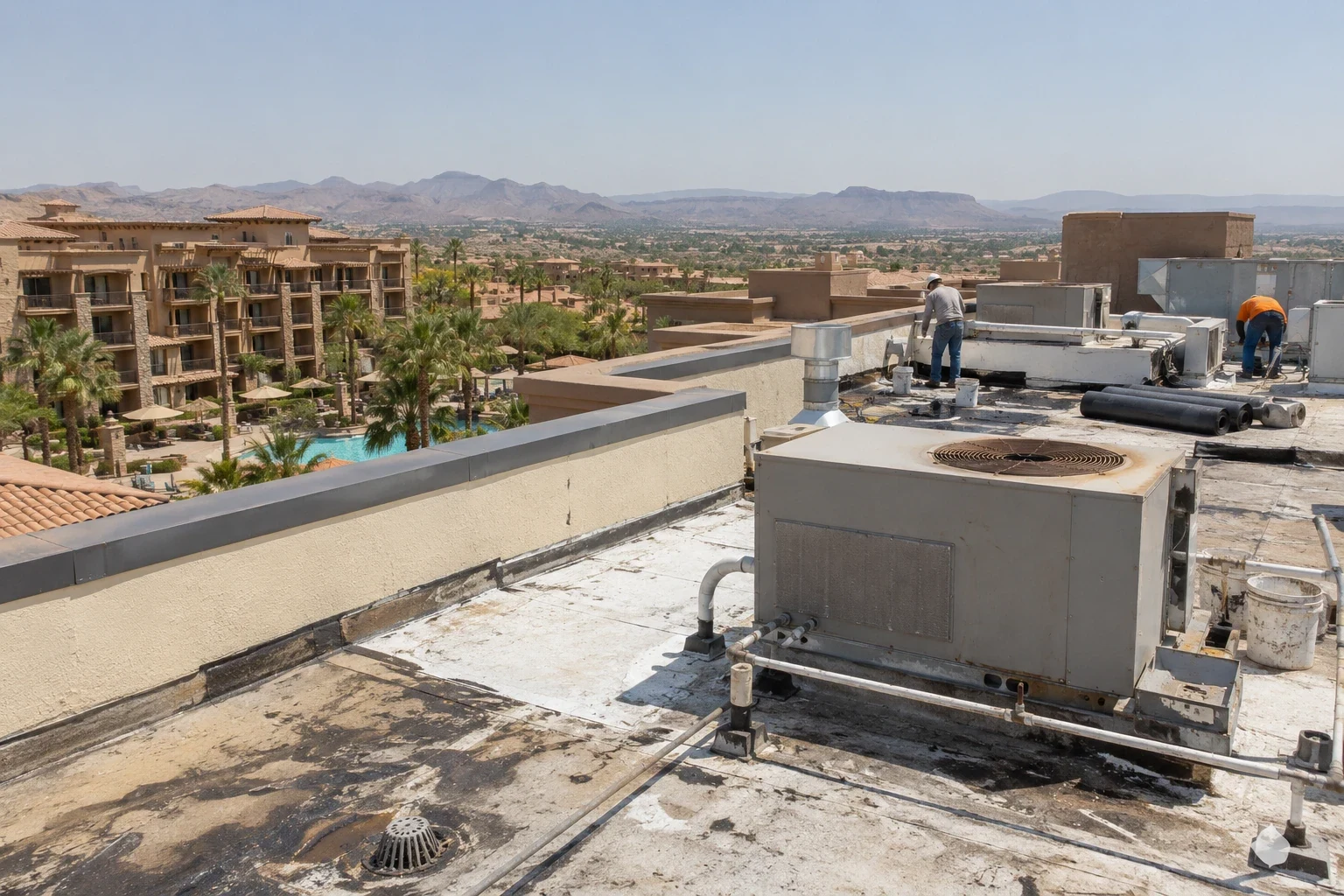
The mechanical sub wants curbs early and units set soon; the roofer wants curbs flashed before units go on. Electrical wants conduit through the roof where it suits them. A clear sequence settles the argument: curbs and blocking first, then membrane and flashing, then units, then final penetrations with a roofer on site to seal each one.
We attend the coordination meetings for the roof and bring a marked-up plan of every penetration with its location, size and responsible trade. Penetrations added after the membrane is complete are priced and installed under the same warranty rules, which is better than a mechanical crew cutting in a pipe and leaving a pitch pocket for someone else to seal in July. Each late penetration also changes the flashing count in the warranty file, so the marked-up plan travels with the project to closeout. Where an owner wants rooftop solar later, we coordinate the layout through our solar-ready roofing details so the first array does not damage a new membrane.
How do heat and the monsoon change a roofing schedule?
Heat limits the day. Crews start early, stop when surface temperatures hurt material handling and do not work through the hottest hours of the afternoon. A roof that would take a week in March can take longer in July, and a GC who budgets time on a mild-climate assumption will land late. We give the GC a daily production figure for each season, so the duration in the schedule reflects the month the work will actually happen.
The August and September monsoon adds hold days. Outflow winds, dust and a few inches of rain arrive quickly, and open sections have to be closed the same day. We plan work in sections small enough to be dried in before late-day storms and keep tie-ins ready for the end of every shift. On a larger project such as one near the Panattoni industrial site beside Highway 195 or in the airport and industrial area, we recommend identifying the monsoon hold in the schedule up front, so the weather days are on the calendar and not a surprise at the owner meeting.
What is different when the GC is renovating an occupied building?
A tenant improvement or a renovation in an operating building changes the roof plan. Dust, noise, access and emergency egress have to be managed, and the roof cannot be opened above an area that must stay in service. Our occupied building reroofing method opens small sections and closes them the same day, which suits a GC who has to keep an owner's tenants running.
Retail work around Yuma Palms Regional Center is one example, where a tenant space of a larger center is fitted out while neighbors stay open and the shared roof must stay watertight. We confirm with the GC which tenants are affected, which roof sections belong to the landlord and which to the tenant, and who signs for the repair if a leak is traced to the new work. Records of the roof as found, with dated photographs, protect the GC from a claim for conditions that existed before the job. The same records help when a landlord's insurer asks whether a leak began before or after the tenant work.
What paperwork does a GC need to close out the roof?
The owner's closeout binder asks for a manufacturer warranty or, where applicable, a contractor's warranty, material data, as-built drawings with penetration locations and a maintenance guide. We deliver each of those in the format the GC wants and track the warranty application so a missing signature does not stall final payment. Warranty management continues after closeout, which matters to owners who keep the file for the life of the building.
For public work, such as school district and public agency projects, the paperwork list is longer, and payroll reports, bonds and insurance certificates are part of it. We keep those documents ready so they are not the last thing holding the GC's pay application. Lien waivers and pay applications follow the GC's own schedule, so the roofing paperwork is formatted to drop into that cycle without a rewrite.
Questions About General Contractors
Do you take roofing scopes for new construction as well as re-roofs?
Yes. New construction scopes depend on the deck being ready and the curbs and blocking installed, so we confirm the readiness list with the GC before mobilizing.
How do you handle unforeseen conditions found at tear-off?
Wet insulation, rotted decking and missing blocking are priced by unit rates stated in the bid, with photographs and measured quantities. The GC gets documentation to pass up to the owner.
Can you work with an owner's preferred membrane?
We install TPO, PVC, EPDM, modified bitumen, built-up, standing seam and other systems, so the owner's system choice is workable. Our role is to price it correctly and detail it for the local heat.
What happens if the roof is not ready on the date other trades need it?
We tell the GC as soon as a delay is likely, with the cause and a recovery plan. Typical causes are material lead times, a late deck release or a storm week, and each has a different fix.
Who inspects the roof before the owner accepts it?
We perform our own walk and photograph every seam and penetration. A manufacturer inspector may also walk the roof when a warranty requires it, and we schedule the visit with the GC.
Send the drawings and the dry-in date
Send the roof drawings, the project schedule and the date the building needs to be dry, and we will return a priced scope with a sequence and a list of coordination items for the other trades.
Call 555-555-5555 or email [email protected].