
Holcim Elevate Roofing Systems in Yuma, AZ
A building that still carries the older Firestone Building Products name on its roof paperwork is carrying a Holcim Elevate system, and the owner should know the two names refer to the same maker. Holcim Elevate, formerly Firestone Building Products, supplies commercial low-slope roofing, which in practice means single-ply membranes, insulation and the metal and accessory components that finish a roof. In Yuma, AZ, where heat on roughly 117 days a year does more work on a roof than rain does, a roof from this maker ages through cumulative sun, and the file an asset manager keeps should show that clearly.
We install, repair and maintain these systems and write the scope with dates, costs and condition evidence so the capital line is easy to defend.
Roof leaking now? Call 555-555-5555 for a site visit and estimate.
Does the name change affect an existing warranty file?
A rebrand does not change the roof, but it can change the paperwork trail. An older warranty may carry the Firestone Building Products name, a newer document may carry Holcim Elevate, and an owner who inherited a building may hold a mix. We read what the file says, record both names in the roof inventory and note the dates, since a warranty has conditions about repairs, inspections and who may make them.
If the paperwork is incomplete, we start from the roof itself. A core cut and the markings on the membrane identify the system, and we build the record from what we can see. The warranty management file then lists what is known, what is missing and what the owner should ask the manufacturer to confirm in writing. For an owner preparing a sale or a refinance, that list is the first page of the roof section in the data room, and a clean one shortens the list of questions that a buyer's inspector brings back after the first site visit.
Related Roofing Work
Other pages that cover parts of the same roof question.
Roof Warranty Management
TPO Roofing
EPDM Roofing
PVC Roofing
Yuma Palms and the I-8 Retail Corridor
GAF Commercial Roofing Systems
Which assemblies does this maker supply?
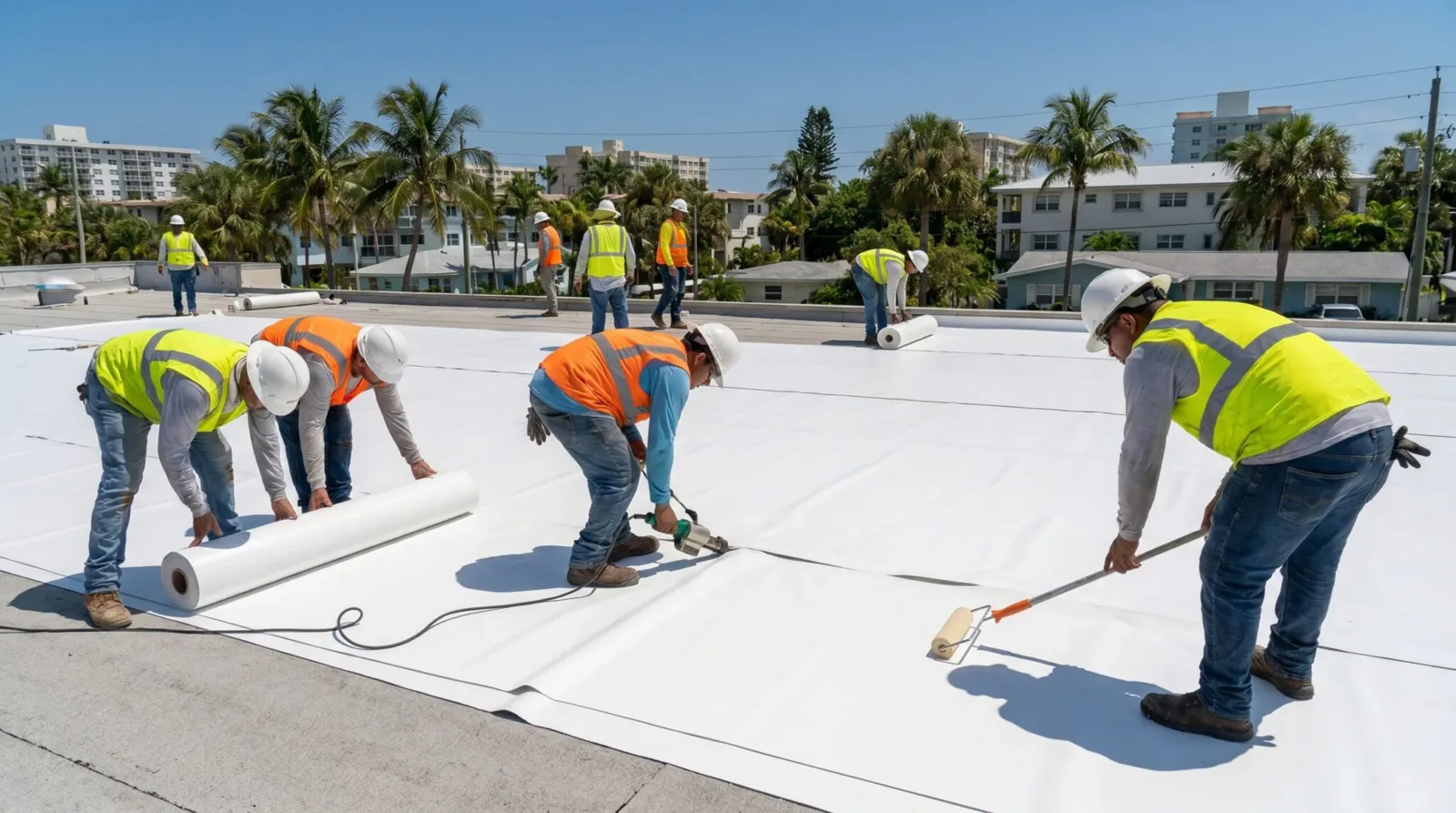
The commercial range centers on single-ply membranes such as TPO, EPDM and PVC, paired with polyisocyanurate insulation and cover boards, and it also includes metal roofing components and edge details. Each membrane type has its own seam method, its own reflectance and its own repair path. A white TPO field reflects sunlight and welds at the seams. An EPDM field is cured rubber with taped or adhered seams. A PVC field welds and tolerates oils.
On a first walk we identify which membrane the roof carries, how it is attached and how old it is. A large retail roof at Yuma Palms and the I-8 corridor may carry a different sheet than a school building, and the repair method has to follow. The scope lists the membrane, the insulation and the edge metal as separate lines, because each has its own life. Edge metal, for example, can outlast a sheet or fail well before it, and the same goes for sealants at terminations. Pricing them apart, with a dated photo for each, lets an owner replace the part that has failed instead of the whole assembly, or confirm that a full replacement is justified. Where the edge metal has failed first, the fix is a line item of its own and the field sheet stays in service.
How should an owner read the heat record?
Heat is the primary clock on a Yuma roof, and the log is built to read it. Surface temperature is taken at several points as the afternoon peaks, reflectance is checked on any white membrane, and the seams along the hottest runs go into a dated photo set. Freeze-thaw is rare here, so the movement the membrane has to absorb is the daily stretch of a hot day followed by a cool night.
An owner who reads the log across several seasons sees a trend. Reflectance that drifts down means the surface is dirtying or weathering. Seam readings that rise mean the sheet is working harder. A trend like that is the evidence for moving a replacement forward or pushing it back, and it is the paper a board or a lender will accept. Without the trend, a replacement date is an opinion. Other makers, such as GAF or Soprema, get the same log, so a portfolio compares on one scale. Monsoon dust matters to the reading too. A roof that has just carried a haboob film reads lower on reflectance until it is cleaned, so we note the dust and retest after a wash before we call the number a trend.
What fits a school or college building?
Arizona Western College in Yuma enrolled about 11,492 students in 2017-18 and operates three residence halls housing up to 348 students. Education buildings come with a calendar that sets the work window, since classrooms and residence halls have quiet periods in summer and between terms. The heat season overlaps that quiet period, which is why a school roof project often has to be sequenced carefully, with the most exposed sections done early in the morning and the dry-in completed before the monsoon.
A multi-building owner benefits from a multi-site roof program, where the buildings are ranked in a single list and the work is phased over budget years. The ranking uses the same fields for each building, whatever the maker, so a district or a college can see which roofs are next without reading each file in full. The program also lets an owner bundle work, since mobilizing once for three buildings in the same neighborhood costs less than three separate visits, and the schedule can follow the academic calendar rather than the order in which leaks were reported.
What happens when a seam or flashing opens?
We locate the failure, clean and prepare the area and repair with compatible materials. On a welded sheet, that means a heat-welded patch or cover strip. On an adhered or taped sheet, it means removing aged adhesive and rebuilding the splice. Flashings at walls and curbs get new terminations and sealant where the old ones have pulled back.
Each repair is photographed before and after, and the file shows its location. Three openings along one wall are a different problem from three openings in three places: the first points to movement, ponding or wet insulation at that wall. A flashing failure that repeats is a sign the detail needs to be rebuilt rather than patched again. The rebuild replaces the old termination, checks the substrate behind it for rot or rust and sets new fasteners and sealant, and the file records the date so the next inspection can check that exact spot first.
Questions About Holcim Elevate Roofing Systems
Is Holcim Elevate the same company as Firestone Building Products?
Holcim Elevate is the name that replaced Firestone Building Products. The roof is the same, and an older warranty may carry either name, so we record both.
Which membrane suits a school roof in Yuma?
A reflective single-ply is common, but the choice follows the building, the equipment on the roof and the budget. We compare installed cost, expected service and repair path.
How can a college sequence roof work around the term?
Plan the work for the quiet summer weeks, start early each day to avoid peak heat and finish the dry-in before the monsoon. Residence halls get notice and a protected access path.
What does a reflectance reading tell an owner?
It shows how much sunlight the surface still reflects. A falling number points to dirt or weathering, and a coating or a cleaning may restore some of it.
Does the Firestone name on a roof mean the system is old?
Not by itself. The name only says which company's name was on the paperwork when the product was made or sold. The roof's age comes from the installation date or from a core cut.
Send the warranty paperwork and the roof plan
Send the roof plan, any warranty file under either company name and the budget year, and we will return a dated scope before the heat season closes the window.
Call 555-555-5555 or email [email protected].