
Flashing Failure Repair on Commercial Roofs in Yuma, AZ
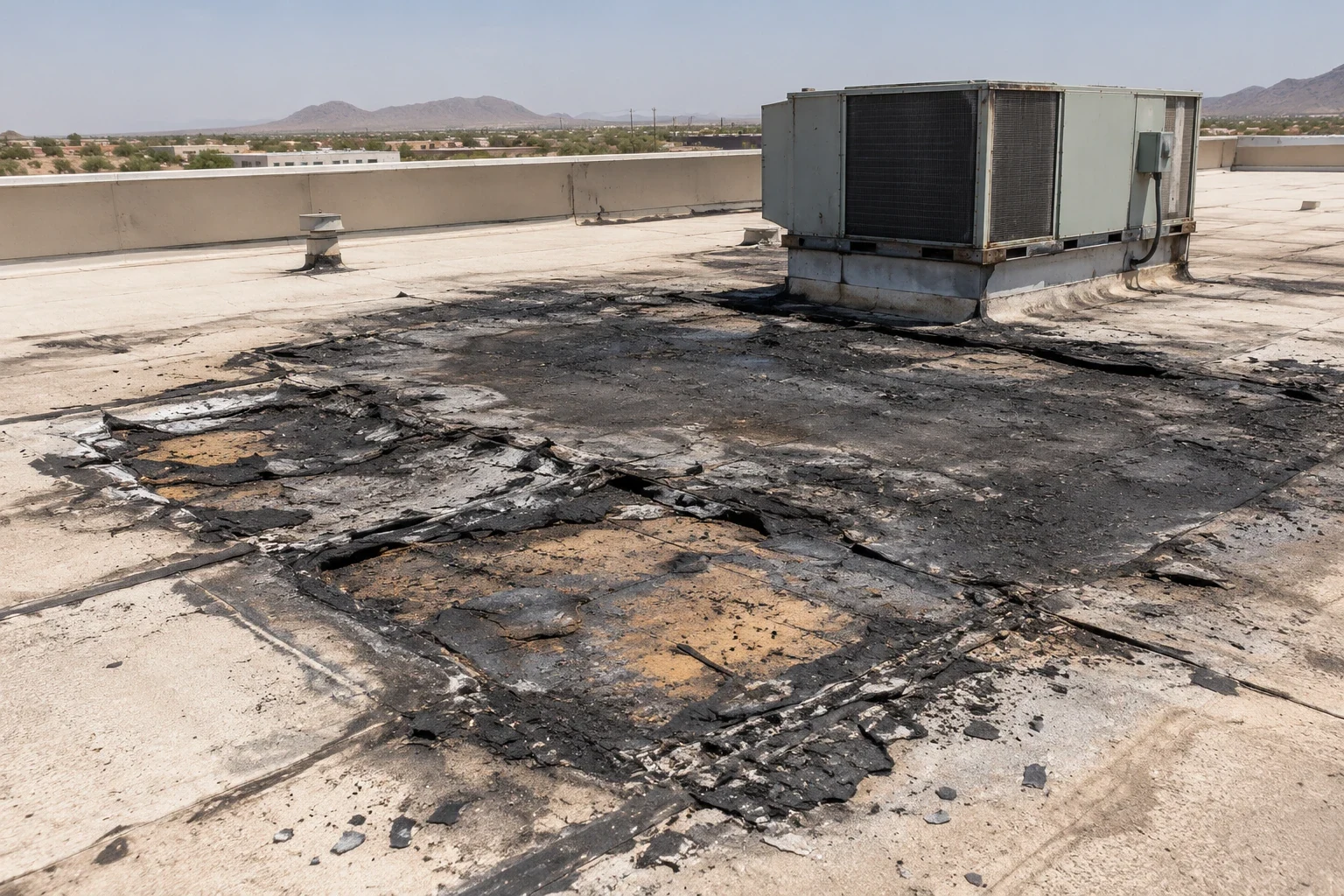
Flashing is the line item that costs the least to repair on a Yuma, AZ roof and the most to ignore, because it sits at every curb, parapet, pipe and wall where the field membrane stops and water finds its first way in. The climate gives flashing a particular punishment: surfaces that reach well past the air temperature on 100 degree days contract overnight, and the movement repeats through roughly 117 days of 100-degree weather each year, so a sealant that was sound in March can be cracked by the August monsoon. Sealants dry, base flashings pull away from walls, and terminations open a hairline that stays harmless through months of dry weather. Then a December storm or an August monsoon week sends sideways rain into every open edge at once.
We repair flashing in the order of consequence, record each detail with a dated photograph and give the owner a priced count of how many details need work now and how many can be tracked.
Roof leaking now? Call 555-555-5555 for a site visit and estimate.
What does desert heat do to flashing that rain does not?
Heat attacks flashing in three ways. It dries and shrinks sealants and mastics until they crack away from the surface they were meant to seal. It makes metal expand and contract daily, which works fasteners loose and opens joints in counterflashing. And it ages the flashing membrane itself, which sits in the same sun as the field but with more movement at the edges and corners.
Yuma's records run from about 21 degrees to 124, but the movement that breaks a sealant bond is the gap between an afternoon peak and the cooler hours after dark. Every cycle pulls on the joint, and thousands of cycles do what no single storm can. Our walk looks for the early signs: sealant with a glazed or crazed surface, base flashing standing off the wall by a fraction of an inch, termination bars with open gaps and caulk joints that have lost adhesion on one side.
Related Roofing Work
Other pages that cover parts of the same roof question.
Rooftop Equipment Curbs and Supports
Edge Metal, Coping and Gutters
Wind Damage Roof Repair
Skylight and Penetration Flashing
Commercial Roof Leak Repair
Silicone Roof Coatings
Why do rooftop equipment curbs leak first?
Every curb is four corners, four walls and a seam where flashing wraps around a box that vibrates, heats and sometimes moves when the unit is serviced. Technicians step on the flashing, set tools on it and sometimes remove a panel that disturbs the seal. After a few service cycles, the seal around a curb has been tested more than any other detail on the roof.
We inventory every curb and support, noting flashing height, termination condition and any signs of movement, and we keep the list as part of the roof binder. Where curbs need rebuilding, the work ties into equipment curb and support repair, which adds proper height, new flashing and walk pads for technicians. On a restaurant pad at Yuma Palms or a medical building with many rooftop units, the count can be high, so the priced scope lists each curb with its own repair method.
Are parapets, walls and edge metal different from curbs?
They are. A parapet or wall flashing carries a long continuous run, and a failure at one point lets water travel behind the flashing and into the wall. Water running down the inside of a parapet shows up as a stain on an interior wall far from the roof edge, which makes the source hard to trace without a careful look from above.
For edges, edge metal and coping provide the top seal on the wall and the drip line at the roof perimeter. Loose coping joints let water into the wall. We check each joint, each fastener and each end cap, and we note where flashing has been pulled by wind. The relationship between flashing and wind is direct, and our wind damage repair work begins at these edge details because they fail first in a gust.
What about pipes, skylights and other small penetrations?
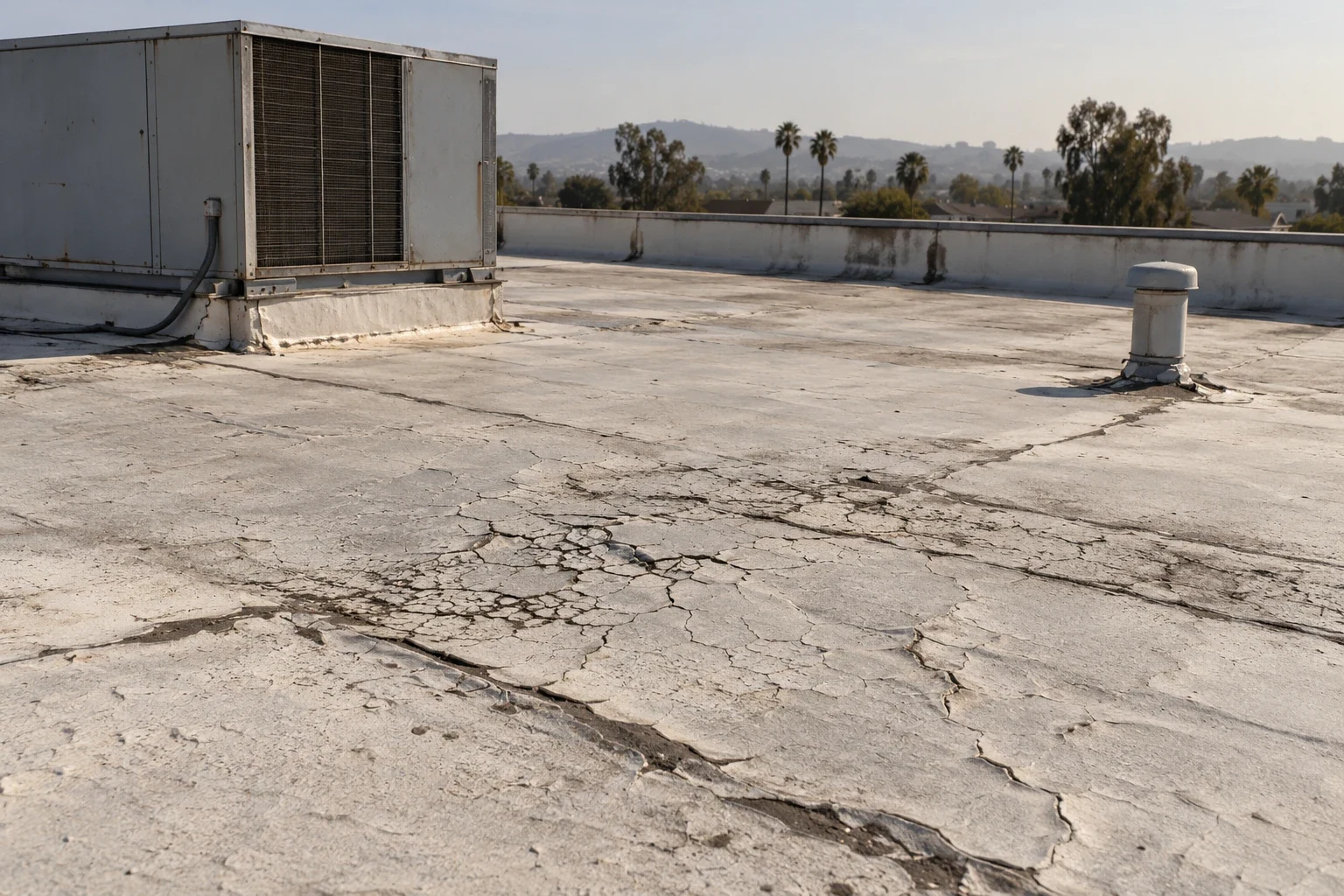
Small penetrations are the most numerous openings in a roof, which gives water many places to start. Pipe boots crack in the sun, pitch pockets shrink and open, skylight curbs lose their seals and conduit penetrations added after the roof was installed can end up sealed with whatever a technician had on hand. In a climate where the sun destroys sealants slowly and steadily, a roof can have dozens of these small weaknesses.
Our skylight and penetration flashing work replaces failed boots, rebuilds pitch pockets with proper details and reseals skylight curbs. Each repair is photographed before and after. We number each penetration on the roof plan with a photograph, so the owner can see exactly which ones were repaired and which are still in service. Where the repair is part of a broader leak repair, the flashing count goes into the scope with a price per item.
Should failed flashing be patched, rebuilt or coated?
The answer depends on the substrate and the amount of movement. A patch of sealant over a cracked joint buys a short window and often fails again in the next heat season. A rebuilt flashing, with new membrane, proper height and mechanical termination, lasts as long as the roof if the surrounding membrane is sound. A liquid-applied flashing resin is a good choice for complex shapes where a membrane cannot be easily formed, such as around clusters of pipes and brackets.
Coatings can extend the life of sound flashings, and a silicone coating over a prepared surface adds a continuous layer around details. It does not rescue a flashing that has detached from its substrate. We tell the owner which method fits each detail and what it costs, so the budget can be built from the right mix. Historic buildings in Downtown Yuma may need flashing profiles that a preservation reviewer approves, which narrows the options. Colorado River State Historic Park keeps five 1864 depot buildings, storehouse and quarters structures, and a wall-to-roof junction on a building of that age is measured and detailed by hand instead of taken from a stock drawing.
Where water collects behind flashing because a low spot holds it, the fix is partly a drainage question, and the same visit may call for ponding water repair next to the detail work.
Questions About Flashing Failure Repair
How can I tell if flashing is failing before a leak shows?
Look for gaps at the top edge of base flashing, cracked or peeling sealant, rust or staining at a curb and metal that has lifted from a wall. A dated photo of each detail from visit to visit shows movement before water does.
Is caulk ever the right repair?
Caulk works as a maintenance item on a sound termination, and it needs to be redone on a schedule that the maintenance record tracks, usually each spring before the heat arrives. As a fix for open or detached flashing it fails quickly in Yuma sun.
Do flashing repairs affect the manufacturer warranty?
They can. Warranty terms often require that flashing repairs follow the manufacturer's details and use approved materials. We read the paperwork first and note any requirements in the scope.
Why does a flashing leak sometimes appear far from the source?
Water travels along decks, insulation joints and wall cavities before it drops into a room, and a parapet stain in a storefront may start a long way from the stain. That is why we use moisture readings and infrared scans to trace a stain to its entry point.
Can flashing be repaired while the building is occupied?
Yes. Flashing work is localized, takes little roof area and can be done with minimal disruption. We plan around tenant schedules and dry in each detail before leaving.
Send the roof plan and a list of past leak locations
Send the roof plan and any records of past leaks, and we will inspect every curb, wall and penetration, number each detail and return a priced repair list.
Call 555-555-5555 or email [email protected].