Metal Roof Retrofit and Restoration in Yuma, AZ
The cheapest roof an asset manager will ever carry is the one already on the building, and an exposed-fastener metal roof is often a better candidate for restoration than its leaks suggest. Corrugated and ribbed panels held down by screws with rubber washers age in a predictable way in Yuma, AZ: the sun and a night-to-afternoon temperature climb make the panels expand and shrink around each screw, the washers dry out, the holes elongate and the screws back out. Each loose fastener is a small leak path that the monsoon will find. A retrofit can mean resealing and re-fastening, coating the whole roof, or laying a new panel system over the old, and each path has a cost, a lifespan and a deferred-cost consequence that we put in writing before work starts.
Roof leaking now? Call 555-555-5555 for a site visit and estimate.
Which path fits: reseal, coat or overlay?
Resealing and re-fastening is the lowest-cost route and suits a roof whose panels are sound and whose problem is limited to fasteners and laps. Coating adds a continuous reflective film over the panels, sealing seams and cooling the surface, and it works when the metal is free from perforating rust. An overlay installs new panels or a standing seam system over the old roof, adding a fresh waterproof surface and a longer life, but it asks the structure to carry both layers. We test each roof with a screw-torque check, photographs of every panel lap and a moisture reading in the insulation below, then present all three paths with the years each adds, so the capital line can be set by data and not by the nearest leak.
Related Roofing Work
Other pages that cover parts of the same roof question.
Standing Seam Metal Roofing
Seam Failure Repair
South Yuma Airport and Industrial Area
Occupied Building Reroofing
Roof Insulation and Cover Board
Commercial Roof Repair
What does Yuma heat do to a screwed-down panel?
Metal moves with temperature, and a screw-fastened panel cannot slide the way a clipped standing seam panel does, so the movement concentrates at the fasteners. Over years, the repeated expansion enlarges the holes and cracks the washers, and the sealant at laps dries out in the sun. The 124 degree F record is an outlier; it is the months of 100-degree weather between April and October that wear the washers. We log surface temperature, count backed-out screws per panel run and photograph the laps on a dated set. That count turns a vague complaint of leaks into a measured fastener failure rate, which tells us whether resealing will hold or whether the holes have worn beyond repair.
Laps get the same attention. Where the overlapping edges of two panels have lifted, the sealant tape between them has usually dried and the water path runs along the rib, so the seam failure is mapped panel by panel. A single loose fastener is a small item on a repair ticket; a pattern of them across a slope is a line on the capital plan, and the survey shows the manager which one the roof has.
Where do these roofs show up around Yuma?
Exposed-fastener metal tends to appear on agricultural support buildings, packing sheds, workshops and older warehouses, the building types that a major winter vegetable county keeps in service. Cold storage and produce packing buildings along the trucking routes of Interstate 8 and U.S. Route 95 are the places where we expect to see ribbed panels over an insulated deck, and where moisture in the insulation is the main worry. In the airport industrial area, older tenant buildings may have metal roofs that the owners want to extend rather than replace. For these, we start with a survey and a clear scope for each building, since the answer for a packing house with a refrigerated interior is different from a dry storage shed. Distribution buildings near San Luis, close to the port of entry that handles commercial trucks, can add another type: warehouse-style buildings with long panel runs that need safe access for the survey, and a repair program that does not interrupt loading. Tying the work to dock schedules matters as much as the sealant chosen.
How does a retrofit proceed on a working building?
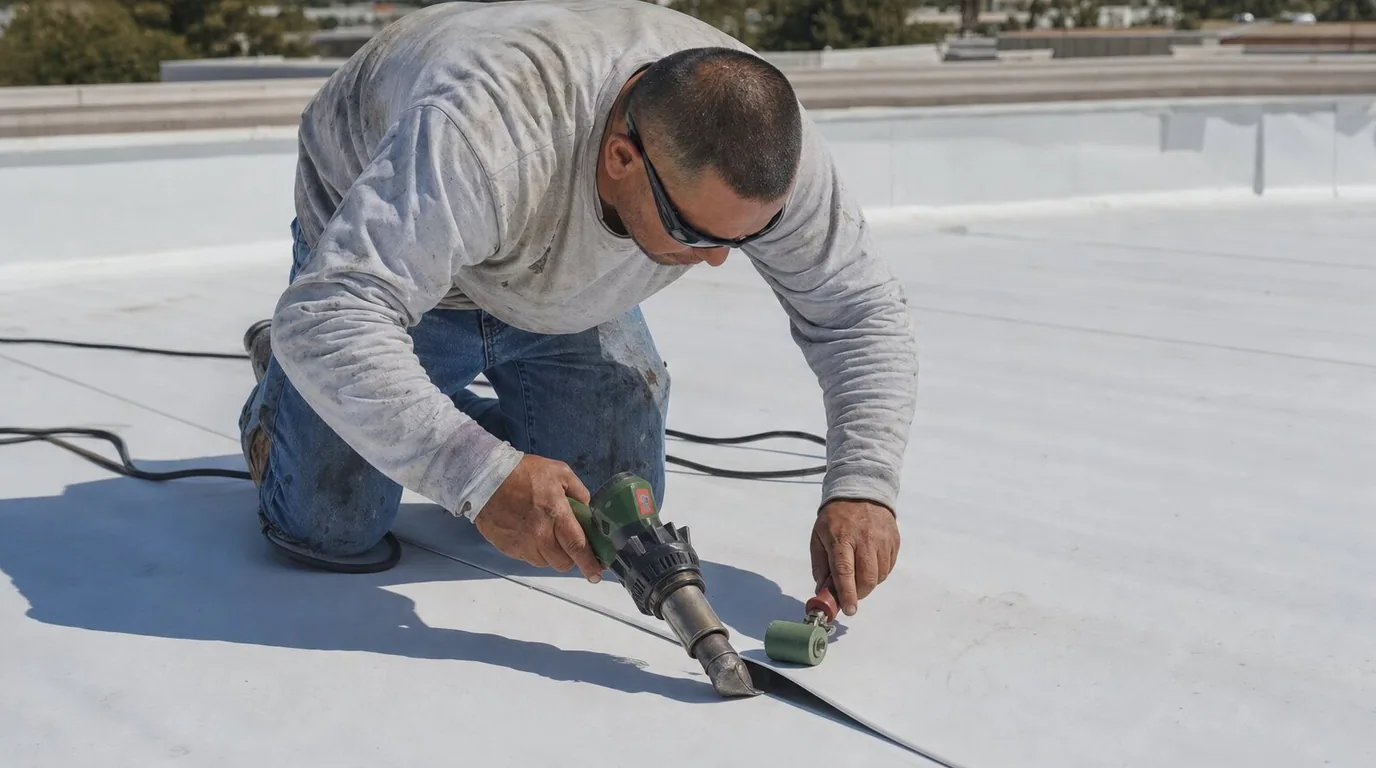
Work happens on the exterior, so the interior can stay in operation, but tarps, staging and noise need planning with the tenant. A typical sequence starts with a wash to remove dust and chalk, then re-fastening with larger-diameter screws set into sound framing, then sealing laps and penetrations with butyl or a polyurethane sealant, then the coating system in two coats. A retrofit on an occupied building is planned around shifts and deliveries, with panel sections closed each day. The August and September monsoon limits the window, since coatings need dry surfaces and cannot be applied just before a storm. We state the hold risk in the bid, so the owner sees the cost of a delay before it occurs. Insulation and cover board are checked at the same visit; where the insulation under a panel is wet, a cover board and insulation repair comes before any coating, since a coating cannot dry a wet assembly. Small leaks that appear during the program are handled as planned repairs with their own photographs, so they do not wait for the final inspection.
What proof is left behind after the work?
The owner receives a dated photograph set of the roof before, during and after the work, the fastener counts by panel run, the sealant and coating batch records, the film thickness readings where a coating is applied, and the warranty file that goes with the coating system. A return schedule follows: a fastener and lap check in the weeks after the storm season, a second in late winter, and a yearly look at the details that were treated. For a manager with several metal buildings, those records produce a ranking by remaining life, which is the base of a reserve schedule. If the roof is later recoated with silicone, the film thickness readings show how much of the original is left, and the next recoat can be scheduled on measured wear instead of the calendar. That record is also what an insurer or buyer will look for if the roof has storm damage or the building changes hands, because it shows that the leaks were found, counted and repaired in an order that can be reproduced.
Questions About Metal Roof Retrofit and Restoration
Can screws just be tightened instead of replaced?
Tightening a screw in an enlarged hole usually makes it worse. The usual fix is a larger fastener in sound framing with a new washer, then sealant over the head. We count the failed fasteners before quoting.
Will a coating stop leaks at every panel lap?
A coating bridges small gaps and seals sound seams, but it will not close a wide opening or hold over active rust. We reinforce seams with fabric and mastic where needed, then coat, and we test small areas with water.
What happens when rust has perforated the panels?
Perforated panels need replacement or cover. We mark rusted areas, treat or cut them out, and prime the remaining metal before sealing or coating. Where perforation is widespread, an overlay or new roof is priced.
Does insulation under an old metal roof matter?
Yes. Wet insulation reduces performance and corrodes the underside of the panel. We run infrared or moisture probes before recommending a coating, because a sealed roof traps moisture that is already inside.
How does a haboob affect a restored roof?
Dust settles on a coating and lowers its reflectance, and the wind carries abrasive sand. Rinsing after a major dust event and checking the film at the next inspection keeps the surface performing as designed.
Send the building list and the leak history
Share the roof plans, the dates of recent leaks and any interior use that limits the work, and we will return a dated scope pricing resealing, coating and overlay side by side. Call to set a walk before the heat peaks.
Call 555-555-5555 or email [email protected].