
Roof Documentation for Insurance Adjusters and Restoration Firms in Yuma, AZ
An adjuster handling a Yuma, AZ commercial claim needs three things from the roofer: what the roof looked like before, what the storm did, and what the repair costs in line items. Monsoon thunderstorms here bring strong winds, torrential rain and haboob dust storms, and Yuma Proving Ground, north of the city, put its top recorded gust at 61 knots, about 70 mph, in August 1996. The same range station logged six inches of rain through the 1992 monsoon, nearly twice a normal Yuma year, and an adjuster has to price inside that spread when a roof used to 3.3 inches annually suddenly shows interior damage. We write the scope for the file, with the dated record that lets the number be checked.
Restoration firms get the same material in a form they can hand to a mitigation crew and a carrier on the same day.
Roof leaking now? Call 555-555-5555 for a site visit and estimate.
How is storm damage separated from heat wear in a desert market?
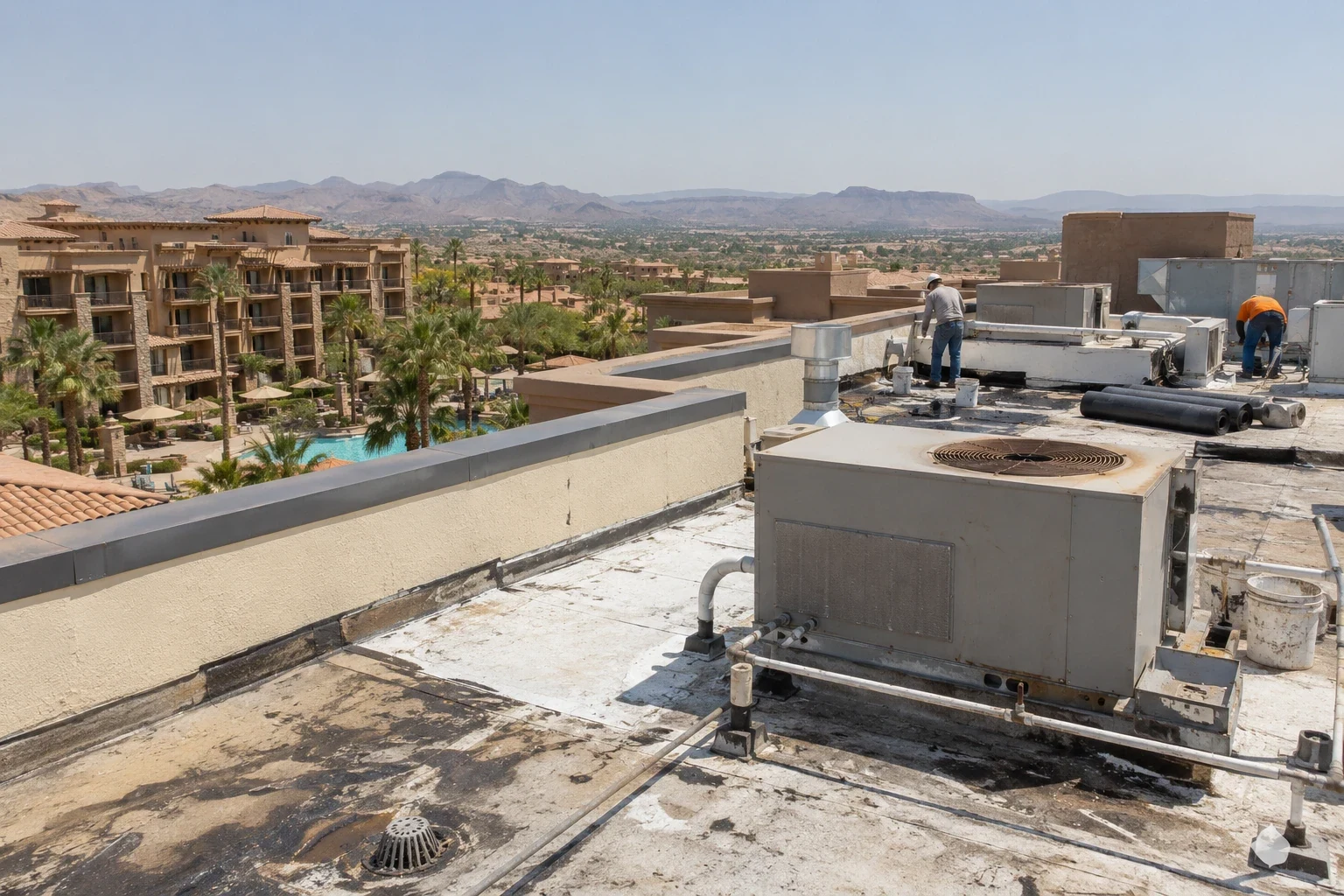
The separation matters because carriers pay for sudden events and not for gradual aging, and in Yuma gradual aging is substantial. With 100-degree weather returning on about 117 days each year, a membrane that looks thin, chalked or cracked may be the product of years of sun and not of last week's storm. We record both and label them separately: what the event did, such as a torn edge, a displaced coping stone or a puncture from airborne debris, and what the climate did, such as seam creep and surface loss.
The photographs are dated and located on a roof plan, and we mark which findings are fresh by the debris pattern, the direction of displaced material and the condition of the exposed substrate. This leaves the adjuster with something concrete to evaluate and gives the owner a clear explanation of why some items are in the claim and others are maintenance. Our claim documentation follows the same structure every time.
Related Roofing Work
Other pages that cover parts of the same roof question.
Roof Insurance Claim Assistance
Wind Damage Roof Repair
Drone Roof Inspection
Yuma Palms and the I-8 Retail Corridor
Fire and Smoke Damage Roof Repair
Emergency Roof Repair
What does wind damage look like after a haboob or an outflow gust?
Outflow gusts lift roofs from the perimeter, so the first places to check are edge metal, coping, the first rows of membrane and any loose rooftop cover. Haboob dust adds a second layer of damage: silt fills drains and scuppers, and the following rainfall has no path off the roof. A roof can survive the wind and fail in the rainfall that follows, and the record has to show the sequence.
Our wind damage repair work begins with securing the perimeter and removing debris, then documenting displaced material and the location of any membrane pull. Aerial imagery from a drone roof inspection shows the pattern across a large roof quickly and keeps people off an unstable surface, which is useful when a carrier wants to see the whole roof before approving access. At a multi-tenant center such as Yuma Palms, whose sold portion alone holds 49 tenants, the same overview saves the most time, and the Yuma Palms and I-8 retail corridor is where we would expect to use it first. A gust that crosses Interstate 8 or Highway 195 can reach several buildings, so the survey runs across neighboring properties to show the pattern of damage.
Timing matters on the record side. Dust and debris move after a storm, and a roof photographed on day one tells a more reliable story than one photographed after a week of foot traffic and cleanup. We time our first visit to catch the roof as the storm left it.
What changes on a fire or smoke claim?
Fire claims involve more than the burned area. Heat damages membrane and insulation well beyond visible char, smoke and water from suppression soak the assembly, and structural members may need an engineer's review before any new roof goes on. We document the fire's reach with photographs and moisture readings, mark which insulation and deck areas are wet or compromised and note the equipment and penetrations that were involved.
The plan for fire damage roof repair separates emergency protection from permanent repair. Temporary covering goes on quickly to protect the interior, while the permanent scope waits for the cause investigation and the carrier's release of the scene. Restoration firms working the interior value this separation because it tells them when they can expect a dry roof above their work.
What happens in the first day after a loss?
The first visit has three jobs: make the building safe, stop the water and photograph everything before it is moved. We answer at any hour, and emergency roof repair starts with temporary measures such as tarps, sealing and drain clearing. Each is priced as temporary work, so the carrier sees what was done to mitigate and what remains for the permanent repair.
Mitigation matters to a claim because a carrier expects the owner to limit further loss. A written log of what was done, by whom and when, shows that the owner acted. Receipts, crew sign-in times and photographs of every temporary measure belong in it. For healthcare and other critical properties, the first visit also includes a conversation with facilities about which interior spaces are most at risk and need protection first. In a mixed set of claims after a storm, we work from the highest consequence down, so an adjuster is not asked to wait for the least urgent site.
What does a repair scope for a carrier contain?
A scope for a carrier names the roof system, the damaged areas by location and quantity, the repair method for each, the material and labor items and any code upgrade or matching issue that applies. Line items are separate from temporary work and from maintenance, so the carrier can accept, adjust or deny each one on its own terms. Where a repair needs more than the damaged area, such as when a patch would not match the surrounding age or system, the reason is stated in plain language with a photograph.
When the claim requires a contractor to coordinate with a builder on a larger rebuild, we work with the general contractor so the roof sequence matches the interior schedule. The finished file, with before and after photographs, material data and warranty documents, goes to the owner and to whoever the owner names, which often includes the carrier and the lender.
Questions About Insurance Adjusters and Restoration Firms
Do you provide a written estimate that an adjuster can compare to their own?
Yes. The estimate lists quantities, unit costs and a method for each repair item, with photographs attached. An adjuster can check it line by line and mark any item they price differently.
Can you meet the adjuster on the roof?
We schedule a joint walk when the carrier asks for one, and we bring the dated photo set so both parties start from the same record. Access, safety equipment and roof plans are arranged in advance.
What if the carrier approves less than the full repair?
We give the owner a written list of what is covered and what is not, with the cost of each. The owner then decides whether to do the full repair now or only the covered portion.
How long do temporary repairs hold?
Through ordinary weather, usually, but a second storm week can test them. We note the expected life of each temporary measure and recommend an inspection after any major wind or rain event.
Can restoration firms get roof access for mitigation work below?
Once the roof is dried in and the entry points are sealed, we tell the restoration firm when interior drying and demolition can proceed without exposing the space to more water.
Send the claim number and the loss date
Send the loss date, the property address and any photographs taken so far, and we will schedule the first visit, secure the roof and return a dated scope the carrier can review.
Call 555-555-5555 or email [email protected].