
Roof Insurance Claim Assistance in Yuma, AZ
Claims on Yuma roofs are won or lost on dates and photographs, because a monsoon week can leave damage that looks like ordinary desert wear unless someone recorded the roof before and after. The adjuster who visits will ask what changed, when it changed and what it costs to put right, and the owner who can answer in dated, itemized form usually has a smoother file than the owner who can only describe a feeling. We do not decide coverage, and we do not argue with an insurer for the owner. What we do is document the roof, separate storm damage from age, and price the repair in a way an adjuster, a lender and an asset manager can all read.
Roof leaking now? Call 555-555-5555 for a site visit and estimate.
What documents does an adjuster expect to see?
The strongest file has five parts: dated photographs of the damage from several distances, a roof plan with the damaged areas marked, a written description of each item, a repair scope with quantities and unit prices, and proof of the roof's earlier condition. That last part is the one owners most often lack. Inspection reports, maintenance binders and earlier photo sets give the adjuster a baseline, and without one the carrier may attribute the damage to long-term wear.
We assemble the first four parts from our own site visit. A drone inspection captures overall views of the field and edges without putting people on a fragile surface, and close-up photography records membrane tears, lifted flashing and displaced equipment. For buildings with a history, a condition report from an earlier date is exactly the baseline the file needs.
Related Roofing Work
Other pages that cover parts of the same roof question.
Drone Roof Inspection
Roof Condition Reports
Heat and UV Roof Damage Repair
Storm Damage Roof Repair
Yuma Palms and the I-8 Retail Corridor
Insurance Adjusters and Restoration Firms
How is storm damage told apart from heat wear?
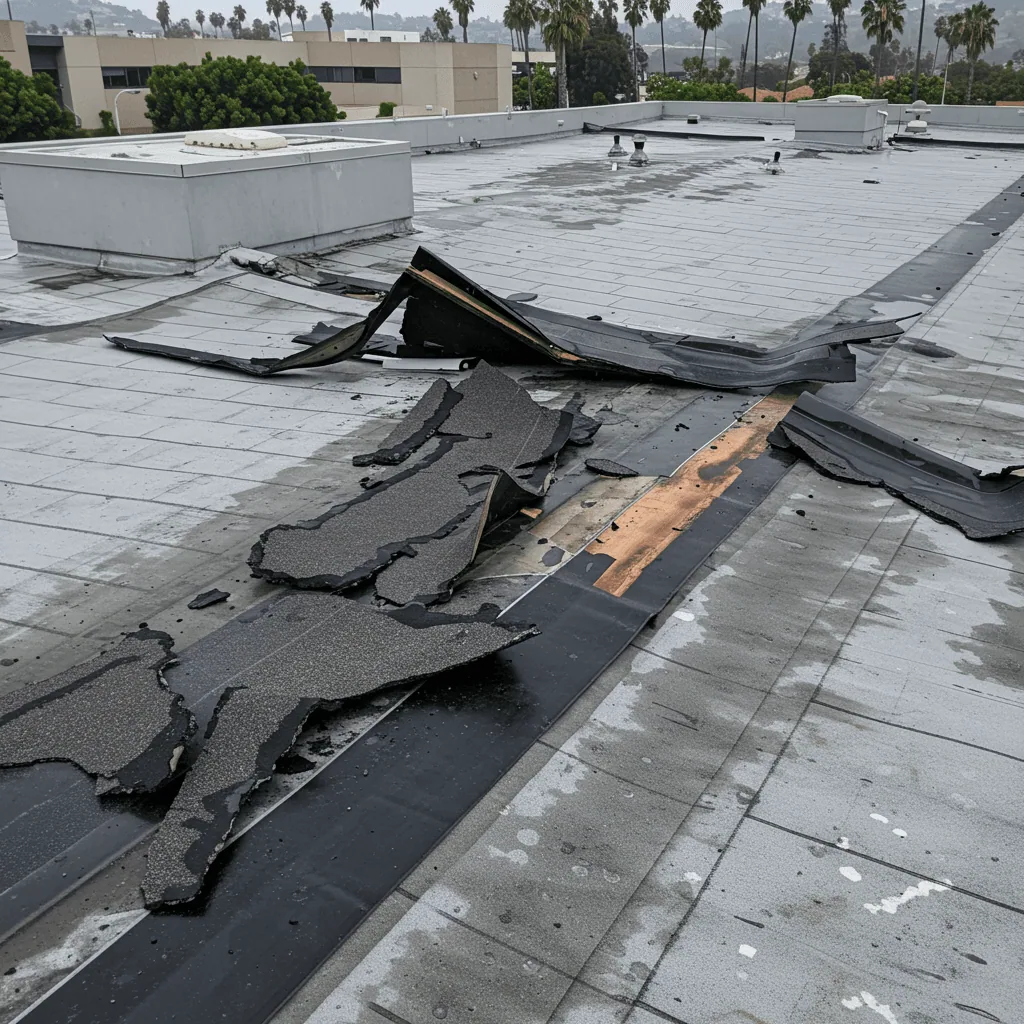
This distinction drives most disputes in a dry climate. A roof in Yuma accumulates sun and thermal damage constantly, through a summer in which 100-degree days stack up by the month, and an adjuster knows that surface crazing, chalked sealant and shrunken membrane are signs of age. Storm damage looks different: a torn sheet, a lifted edge, flashing pulled off its fasteners, equipment displaced from its curb, punctures from wind-borne debris. We mark which items fall into which group, and where they are close we say so in the scope and photograph both conditions.
That is also where the heat and UV damage repair belongs, as a separate line the owner funds through maintenance and capital budgets, not through the storm file. Keeping the two apart makes a storm claim cleaner and a capital plan more accurate.
How soon after the storm does the file need to start?
Sooner is better, for three reasons. Rain finds the opening and wet insulation grows more expensive each day, policies often set notice periods and mitigation duties, and debris, dust and later weather alter the evidence. Monsoon season in Yuma runs through August and September, with December rain adding a second window, and a storm in either period can be followed by another within days. We photograph the roof before temporary repairs where it is safe to do so, make the building secure, and keep every receipt so that the cost of emergency measures can be presented along with the permanent repair.
The first call is often handled through storm damage roof repair, and the same site visit that stops the water supplies most of what the claim needs.
Ahead of the next storm season, owners can do one useful thing at no cost: have the roof photographed in its present condition and store the set with the building records. A dated set taken in spring turns the August argument about what the roof looked like into a comparison of two sets of pictures, and it takes a single morning on most buildings.
What does an itemized repair scope look like?
A good scope reads like a list of purchases. Each line names the area, the work, the quantity and the price: so many linear feet of edge metal reset, so many square feet of membrane replaced, so many curb flashings rebuilt, so much insulation removed and replaced. Allowances are labelled as allowances and conditions that could change the price, such as wet insulation found beneath a tear, are stated as conditions rather than folded into a total.
Itemization helps everyone. The adjuster reads exactly what is requested, the owner can compare it to any competing estimate, and a lender reviewing a loss can follow the money. When the carrier's estimate differs from ours, the line-by-line format shows where, whether in quantity, method or unit price, and that makes the conversation shorter and more specific.
Photographs are tied to scope lines by number, so a tear on the north edge is photographed, measured and priced under one reference. That discipline saves a second site visit, and it keeps the file intact if the person who handled the first call has left the company by the time the carrier responds.
Which owners benefit most from preparing early?
Retail owners at Yuma Palms and along the I-8 corridor answer to a long tenant list that runs from Best Buy to Ulta Beauty, so a storm that disturbs rooftop equipment can produce several small claims at once; a prepared file keeps those items organized by tenant bay. Hospital owners, including the Onvida Health campus, have patient areas below the roof, and the cost of interior protection belongs in the claim alongside the membrane repair. Owners of produce and cold-storage buildings should document refrigeration downtime separately from the roof repair itself, since the two are priced and argued differently.
Public agencies and school districts often operate under procurement rules that require written scopes, so an itemized document built for a claim also serves for bidding. The insurance restoration trade has its own vocabulary, and we write scopes that translate between roofers and adjusters, using plain terms for the work and the standard names for the materials.
Questions About Roof Insurance Claim Assistance
Do you file the claim for us?
The owner or manager files with the carrier. We supply the photographs, the damage description and the priced scope, and we meet the adjuster on the roof when asked.
What if the adjuster says the damage is just wear?
Show the baseline photographs and the dated condition report. We can walk the roof with the adjuster and point out the torn seams, lifted edges and displaced equipment that point to a storm.
Should we repair before the adjuster visits?
Make the building safe and stop the water, but leave permanent repairs until the adjuster has seen the damage or approved the scope. Keep removed material when possible.
Can one storm produce more than one claim?
A property with several buildings or tenants may have items that belong to different policies or deductibles. We tag each photograph and scope line by building so they can be sorted.
How long does the documentation take?
A site visit and photo set usually fit in a day for a typical building, while a written scope follows once measurements and pricing are complete. Larger roofs take longer.
What does it cost to prepare the documentation?
Pricing follows the size of the roof and the amount of damage to record. We quote the site visit and the written scope before starting, so the owner sees the figure first.
What can claim assistance not do?
We cannot promise a payout, a coverage position or a timeline for the carrier. Policies differ on wind, water, deductibles, depreciation and requirements for matching materials, and the decision belongs to the insurer. What we control is the quality of the documentation, the clarity of the scope and the speed of the repair. When coverage is denied or reduced, the same file serves the owner's next decision: appeal, partial repair or a planned replacement through capital planning.
The claim file also helps even when nothing is paid. It records the roof's state on a given date, which is evidence for the next budget cycle, a sale disclosure or a warranty discussion with the original installer.
Start the claim file with the roof plan
Send us the roof plan, the date of the storm and any earlier inspection records, and we will schedule a documented site visit and return an itemized scope in time for the adjuster's review.
Call 555-555-5555 or email [email protected].